
How to Search Boulder County Court Records
The official path begins with the Colorado Judicial Branch Boulder County page. That page lists the courthouse, hours, the records email, and a link to the statewide docket search. Free docket search is the fastest way to find a hearing date or confirm that a case exists. It is not the same as full document access. The docket portal returns case numbers, parties, divisions, and hearing settings; it does not return scanned filings.
Before starting, gather what you know. A case number works best. Format is year, case class, and sequence, such as 2024CR1234 or 2023DR567. If you only have a name, plan to add Boulder County, court type, and a date range to satisfy the docket rule that at least one filter beyond date is required. For document copies, the court routes requests through a single online form. Mailed and email requests are also accepted. The Boulder court records inbox is 20recordsrequest@judicial.state.co.us.
- Open the Colorado Judicial Docket Search and pick County = Boulder County, plus a date range.
- Choose Court Type. Use District for felony, divorce, probate, juvenile, and larger civil; County for misdemeanor, traffic, small claims, and lower civil.
- Enter a party name or the case number parts (4-digit year, case class, sequence).
- Review the docket entries returned. The portal shows hearings and division, not document images.
- To get copies, file the statewide Record/Document Request Form with case number, year, names, and the documents you want.
Limited online register-of-actions access is sold by approved commercial vendors named in the Judicial Branch public records access guide. Those vendors charge per use, do not provide certified copies, and are not the official court record. Use them for quick lookups; rely on the court for binding paper.
The Boulder County Judicial System
Boulder County's state trial courts run as the 20th Judicial District. The district covers one county, not several, so "20th Judicial District" almost always points back to Boulder County alone. District Court is the general jurisdiction trial court. County Court is a court of limited jurisdiction inside the same combined court. Magistrates handle assigned matters under judges. Appeals leave Boulder and go to the Colorado Court of Appeals, then up to the Colorado Supreme Court if review is granted.
The Chief Judge is Nancy W. Salomone (Division 13). District Court judges include Robert R. Gunning, Michael Kotlarczyk, J. Chris Larson, Dea M. Lindsey, J. Keith Collins, Andrew Hartman, Thomas F. Mulvahill, and Timothy Johnson. County Court judges include Jonathon P. Martin, Monica Haenselman, Zachary Malkinson, Eang M. Man, and Elizabeth Brodsky. Magistrates Elizabeth H. Kelley, Nicholas Trevino, Carolyn McLean, and Thomas M. Ward cover Divisions J, M, O, and T. The acting Clerk of Court is Megan Cain.
The Boulder County Sheriff is Curtis Johnson. The Boulder County elected Clerk & Recorder is Molly Fitzpatrick; she handles deeds, recordings, marriage licenses, motor vehicle, and elections, but not court case files. The District Attorney for the 20th Judicial District is Michael Dougherty. Each office sits in a different building. Pick the right one before you call.
Case flow: County Court › District Court › Colorado Court of Appeals › Colorado Supreme Court
The hierarchy table below maps the four levels to the matters most likely to interest people pulling Boulder County court records.
| Court | Jurisdiction | Case Types |
|---|---|---|
| Colorado Supreme Court | Highest state court; final state appeal | Reviews Colorado legal questions; supervises Judicial Branch rules |
| Colorado Court of Appeals | Intermediate appellate court | Most appeals from Boulder County District Court |
| District Court (20th Judicial District) | General jurisdiction trial court | Felony, domestic relations, probate, juvenile, larger civil, Rule 120 foreclosure |
| County Court | Limited jurisdiction | Misdemeanor, traffic, small claims, county civil, preliminary matters |
| Municipal Courts | City code and traffic | Boulder, Longmont, Lafayette, Louisville, and other city ordinance cases |
An overview of the structure is published by the Colorado General Assembly's 2025 Judicial Branch overview. The judges' roster lives on the Boulder County judges and staff page.
Boulder County's official 20th Judicial District page lists courthouse cards, hours, and local links for Boulder court records. 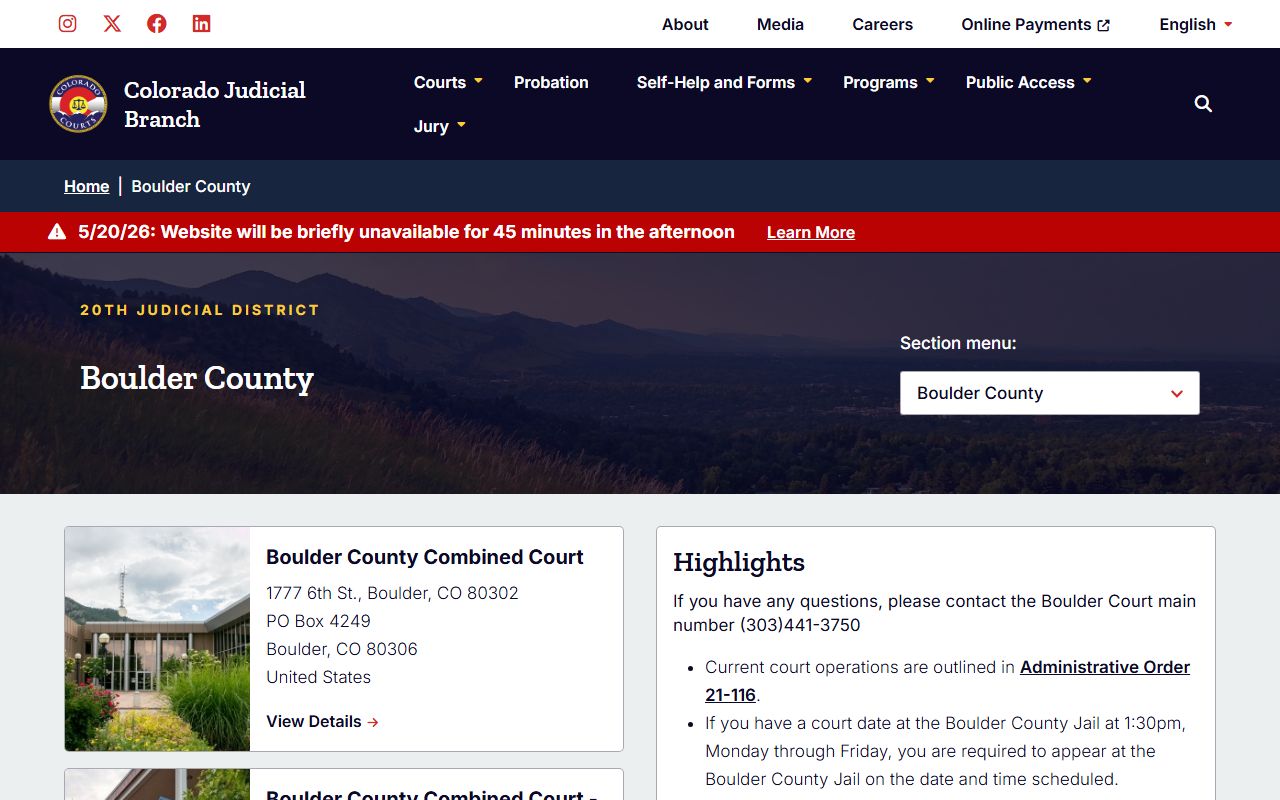 The page is the right starting point for the Boulder County court directory, division contacts, and court-resource information for the public.
Boulder County Courthouses
Boulder County operates the Combined Court at one main address with a satellite in Longmont. The main court holds district court, county court, magistrate divisions, court administration, jury services, collections, the research/records department, the Family Court Facilitator, and the Court Resource Center. The Longmont satellite handles Longmont filings and hearings on its own clerk schedule. Both are part of the same 20th Judicial District. The Boulder courthouse phone is 303-441-3750 and the Longmont phone is 720-564-2522.
The two location pages are linked below as address cards. Each office uses a different clerk-hour schedule, so confirm hours before a same-day visit.
Boulder County Combined Court - Longmont
1035 Kimbark St.
Longmont, CO 80501
720-564-2522
Filings can be mailed to ATTN: Clerk of Court, PO Box 4249, Boulder, CO 80306 for both Boulder and Longmont. After 4 p.m., the Boulder page tells filers to ring the doorbell by window #1 for a Temporary Protection Order, Motion to Restrict, or TERPO/ERPO. Longmont uses a doorbell by the service window. County Court civil returns are Wednesday afternoons at 1:30 p.m. in Boulder and Friday afternoons at 1:30 p.m. in Longmont, except holidays and the Friday after Thanksgiving.
Types of Court Records Available in Boulder County
The Boulder County Combined Court keeps a wide set of files. Each case type has its own class code that drives docket search and copy requests. Civil cases include district and county civil money matters, evictions (FED), small claims, name changes, and Rule 120 foreclosures. Criminal files are felony (CR), misdemeanor (M), and traffic (T) records. Domestic relations files use DR. Probate uses PR. Juvenile uses JD and JV. Each class also affects redaction rules, public access, and request handling.
Public access to most adult civil and criminal docket entries is broad. Access to juvenile, sealed, suppressed, probate-protective, mental-health, and adoption files is restricted. The Recording Division at the Clerk & Recorder, not the court, holds deeds, plats, liens, UCCs, mining claims, and recorded marriage and civil union licenses.
- Criminal records (CR, M) - Felony and misdemeanor case files with charges, pleas, dispositions, and sentences.
- Civil records (CV, C, R) - District and county civil money cases, including judgments and writs.
- Domestic relations (DR) - Divorce, parenting, support, separation, and protection-order matters.
- Probate (PR) - Decedent estates, wills, trusts, guardianships, conservatorships, and minor settlements.
- Traffic records (T) - Citations, county court traffic dispositions, and infractions.
- Small claims (S) - Lower-dollar civil disputes filed in county court.
- Juvenile (JD, JV) - Delinquency and Children's Code files; mostly restricted from public view.
Other Boulder court records covered in more detail elsewhere include warrant records, inmate records, released inmates, court dockets, and public records held by county departments.
What Boulder County Court Records Show
A Boulder County court record is structured around fields. Some fields are visible in the free docket search; others appear only when a document copy is pulled. The case number is the anchor. It carries the year, the class code, and a sequence, so 2024CR1234 reads as a 2024 felony filing. Party names, hearings, division, and the judicial officer follow in the register of actions. Charges, sentences, and dispositions live in criminal and traffic files. Decrees, parenting plans, support orders, and separation agreements live in DR files.
The table below maps the core fields that appear in Boulder County court records to what they show. Field names come from the docket portal and the court's record request form.
| Field | What It Shows |
|---|---|
| Case Number | Year + case class + sequence, e.g., 2024CR1234, 2023DR567, 2025PR89, 2026T999999. |
| Court / Location | Boulder County Combined Court or Boulder County Combined Court - Longmont. |
| Court Type | District or County, which controls case scope and appeal route. |
| Division | Boulder uses numbered District (1-14) and County (7-11) divisions plus letter magistrate divisions J, M, O, T. |
| Judicial Officer | District judge, county judge, or magistrate hearing the case. |
| Parties | Plaintiff/defendant, petitioner/respondent, People/defendant, or estate names. |
| Filing Date | Date the initial complaint, information, or petition was filed. |
| Register of Action | Brief chronology of charges, motions, orders, hearings, dispositions, and sentencing entries. |
| Disposition | Outcome: guilty, not guilty, dismissed, dismissed with prejudice, withdrawn, or transferred. |
| Sentence or Judgment | Imposed sentence, money judgment, decree of dissolution, or letters in probate. |
Documents themselves are not downloadable from the official docket. They are requested through the court record/document request form or by writing to 20recordsrequest@judicial.state.co.us. The court flags juvenile, probate, suppressed, and sealed matters as ID-required.
Public Access Laws for Boulder County Court Records
Colorado uses a layered set of public access laws. General government records fall under the Colorado Open Records Act (CORA). Criminal justice agency records fall under the Colorado Criminal Justice Records Act (CCJRA). Court case records are controlled by Chief Justice Directive 05-01 and related court rules. Judicial administrative records are governed by Colorado Supreme Court Chapter 38 Rule 2. Boulder County government handles CORA requests through department custodians and an Open Records Center; the Colorado Judicial Branch handles court file requests through the court or its online form.
The statutes below are the most relevant access laws for Boulder County court and criminal justice records.
Key Statutes:
Colorado Revised Statutes § 24-72-201 - CORA's policy section; sets the rule that public records should be open unless a specific law restricts access.
Colorado Revised Statutes § 24-72-203 - CORA inspection rule; public records open at reasonable times, with response generally within three working days plus seven for extenuating circumstances.
Colorado Revised Statutes § 24-72-204 - CORA denial grounds for confidential, private, security, or investigatory categories.
Colorado Revised Statutes § 24-72-302 - CCJRA definitions of criminal justice agency, criminal justice records, and basic identification data.
Colorado Revised Statutes § 13-32-104 - Court copy, certification, exemplification, and transcript-of-judgment fees.
CJD 05-01, the Judicial Branch public access guide, and Boulder County's CORA page are the working tools for almost every record request in Boulder County.
The Boulder County CORA page spells out the open-records process and the custodian framework used across all county departments. 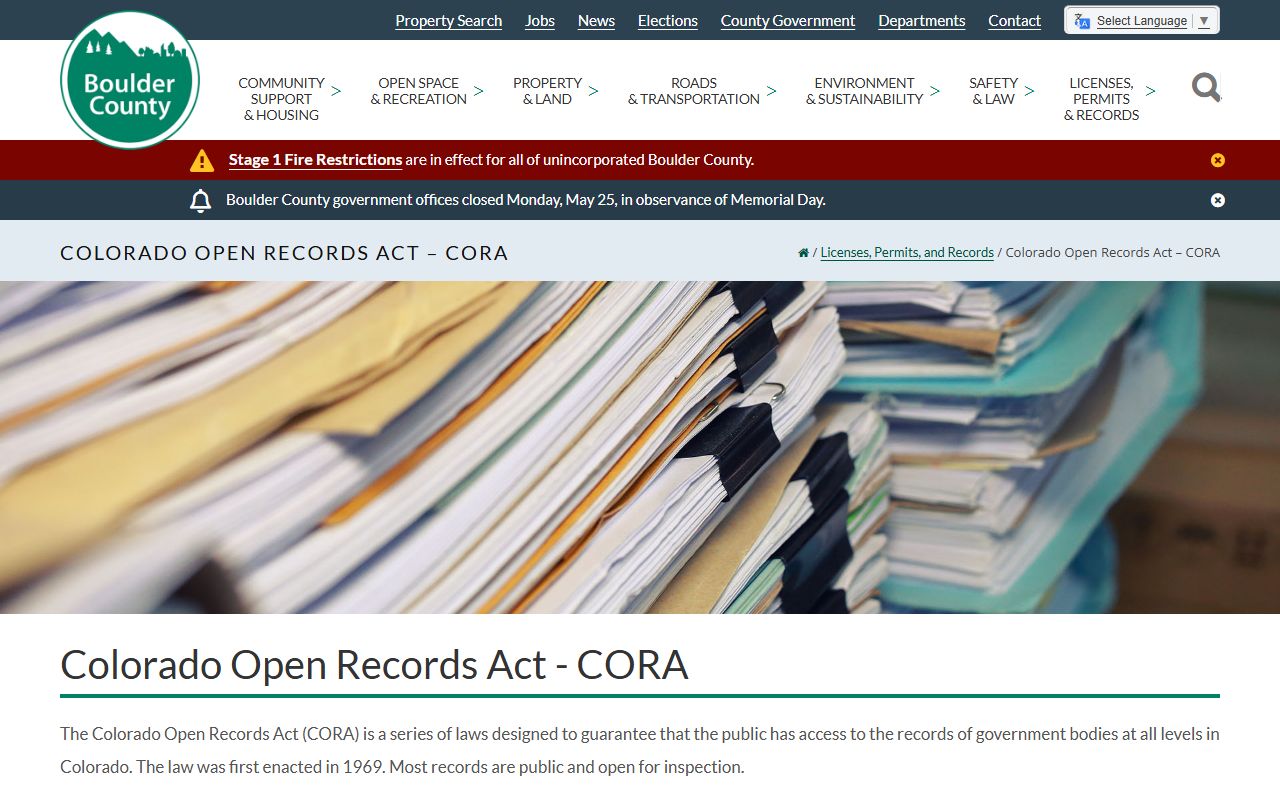 CORA covers county records held outside the court. Court case files still route through the Clerk of Court and the statewide record request form.
Records That Are Restricted or Confidential
Not every case file is open to the public. Juvenile delinquency, dependency and neglect, adoption, and Children's Code matters are restricted by Title 19 and CJD 05-01. Sealed adult records, expunged juvenile records, mental health proceedings, grand jury material, sealed search warrants, and adoption files all sit behind extra access rules. Probate guardianship and conservatorship files often contain medical, financial, or minor-protected data that can be redacted. Victim addresses, personal identifiers, and protected-address designations are removed from public view.
Sealing is not the same as expungement. Sealing hides a record from ordinary public access but keeps it visible to courts, law enforcement, prosecutors, and agencies that run background checks. Expungement, used mostly in juvenile cases, removes the record more completely. To open a sealed record, a person usually needs a court order, party status, attorney status, or statutory access. Petitions to seal an adult criminal record are filed in the court that handled the case. The Colorado General Assembly publishes a sealing and expunging process memorandum that lays out the basics. Most arrest and criminal records from successful pretrial diversion are automatically sealed under the Boulder DA's diversion program.
Specialty Courts and Programs in Boulder County
The Boulder County Combined Court runs a few specialty access points that change how records and dockets work. The DA's Center for Prevention and Restorative Justice handles juvenile and adult diversion, and successful completion can result in dismissal and automatic sealing under Colorado law. The Court Resource Center provides self-help for self-represented litigants. The 20th Judicial District also operates a Walk-In Warrant Information process to let defendants with active warrants add cases to the docket and address the warrant before arrest. Some Victim Rights Act crimes are not eligible.
The 20th Judicial District also takes part in the statewide court text reminder program under C.R.S. 13-3-1021(14). Reminders cover upcoming criminal (CR, T, M) and juvenile (JD) court dates, missed dates, and unplanned court closures. Form JDF 18 can be filed for each case and mailed to ATTN: Court Text Reminder Program, PO Box 4249, Boulder, CO 80306, or dropped off at the Boulder or Longmont Clerk's Office. These programs feed dockets, set future hearings, and change what shows up later in a Boulder County court record.
Boulder County Sheriff and Jail
The Boulder County Sheriff's Office runs jail operations, daily booking and listing reports, sheriff records, warrants, and victim assistance. Sheriff Curtis Johnson was elected in November 2022 and sworn in January 2023 for a four-year term. Sheriff's headquarters sits at 5600 Flatiron Parkway, Boulder, CO 80301; the main line is 303-441-3600. The Boulder County Jail is at 3200 Airport Road, Boulder, CO 80301, with a main line of 303-441-4600 and booking/bond information at 303-441-4650. Jail records older than the current cycle are pulled from the Records Division at 303-441-3600.
The Sheriff publishes a Power BI Daily Booking and Listing Reports tool. It includes a name search of current inmates, a daily release report from midnight onward and for the next 24 hours, current population data by arresting agency, gender, sentencing status, ethnicity, race, length of stay, and historical jail statistics. The tool launched in its enhanced form on October 30, 2024. Sheriff records, mugshots, and dispatch recordings are released by the Records Section with a $5 search fee for up to 10 pages and $0.25 per page after. Fees are waived for victims indexed in a report.
Use Boulder County inmate records for full roster details and warrant records for active warrants. Released-custody questions belong on the released inmates page. Capacity, demographic, and trend numbers live on the inmate population page.
The Boulder County Sheriff homepage features Sheriff Curtis Johnson and quick links to jail and records pages. 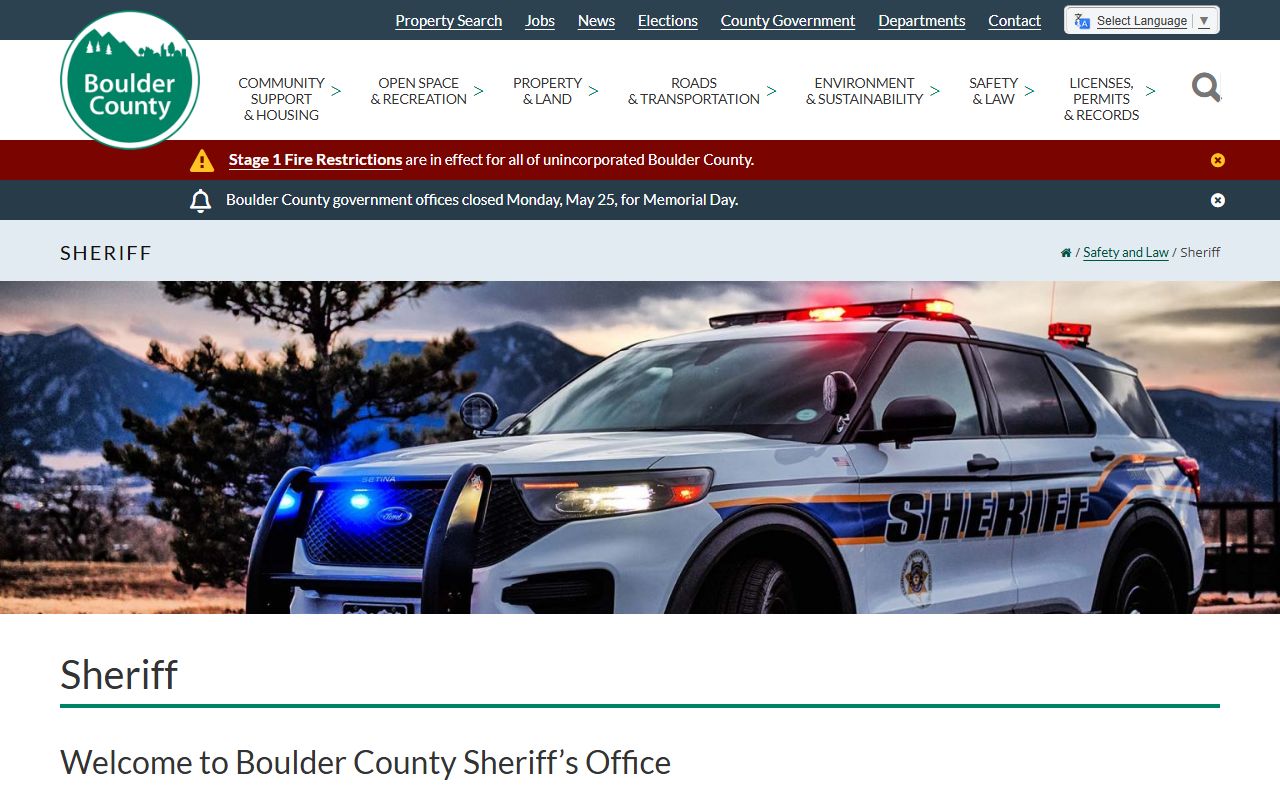 The homepage is the right entry point for jail records, daily bookings, civil process, and warrants information in Boulder County.
Marriage, Divorce, and Probate Records
Marriage licenses are issued by the Boulder County Recording Division, not the court. The license fee is $30 and the process is online only. Both applicants must be in the same room and physically in Colorado during a Microsoft Teams video appointment. Divorce records are court records under the DR class and are pulled through the court record request form. See the marriage and divorce records page for the full walk-through. Probate cases are filed in District Court at the Boulder County Combined Court and use the PR class. The probate records page covers wills, trusts, letters, guardianships, and conservatorships.
A short glossary helps when reading probate filings.
- Testator
- The person who made the will.
- Executor
- The personal representative named in a will to administer the estate.
- Intestate
- Dying without a valid will; Colorado statutes set the distribution order.
- Conservator
- A fiduciary appointed in probate to manage a protected person's financial affairs.
- Guardian
- A fiduciary appointed to care for a minor or incapacitated adult.
Boulder County recorded records go back to 1860 per the Recording Division FAQ. That makes Boulder a strong county for genealogy and old chain-of-title research. Recorded marriages, civil unions, deeds, liens, plats, mining claims, and UCCs all live in the Recording Public Search, not the court docket.
Boulder County Court Records Fees
Court copy and certification fees are set on the statewide Colorado Judicial fee schedule. Many filing fees rose on January 1, 2025 under HB 2024-1286. The Boulder County Clerk of Court follows the same schedule.
| Item | Amount |
|---|---|
| Single-sided copy per page | $0.25 |
| Double-sided copy per page | $0.50 |
| Certifying a copy | $20 |
| Exemplification | $20 |
| Name search | $5 |
| Research / redaction (after first hour, in 15-minute increments) | $30 per hour |
| Transcript of judgment | $25 |
| Petition for divorce, separation, or annulment | $260 |
| Probate first filing (decedent estate, guardianship, conservatorship) | $229 |
| Small claims plaintiff filing ($0-$500) | $31 |
Recording Division fees are separate. As of July 1, 2025, the basic recording fee is $43 per document, a marriage or civil union license application is $30, and a certified copy of a marriage license is $1.25. The full Recording Division fee list covers UCC fees, plats, mining claims, deeds, and documentary fees.
The court's filing and copy-fee schedule lists costs by case type and copy class. 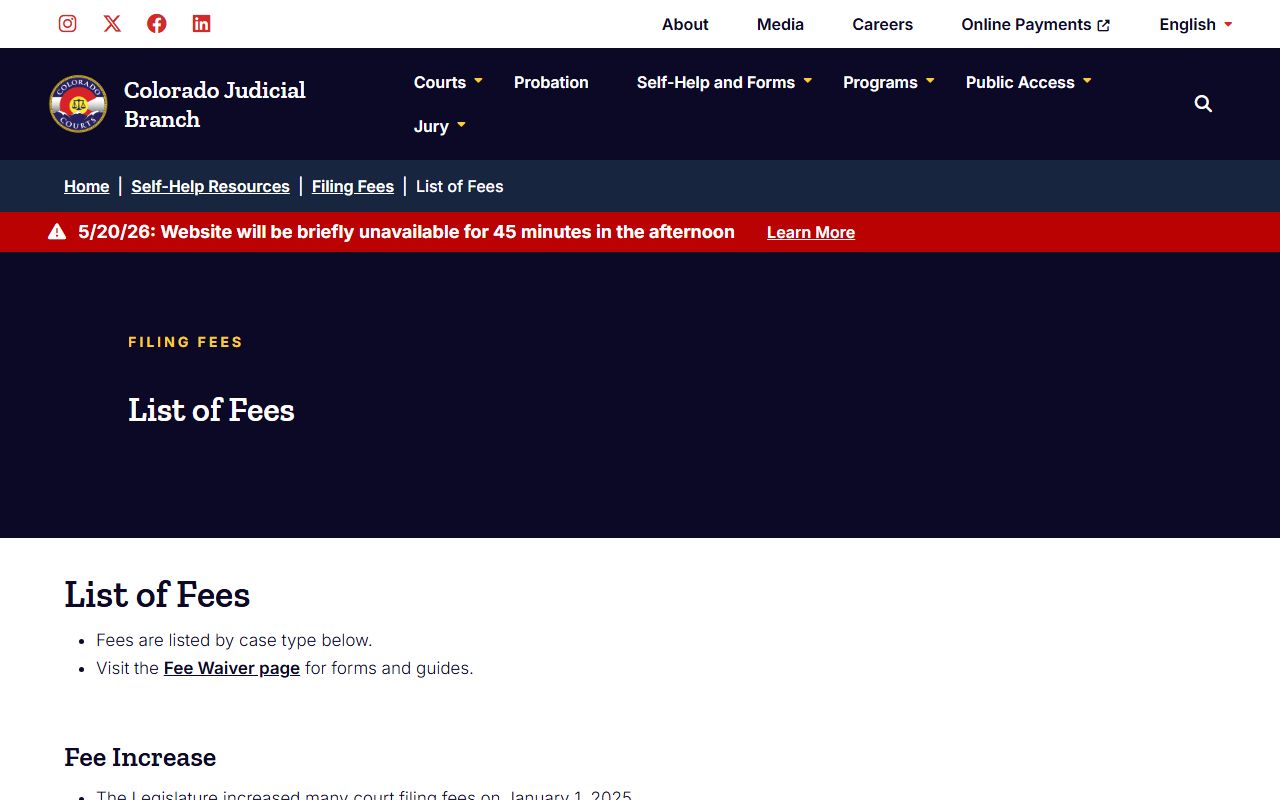 The published schedule is the source of every Boulder County court records fee shown above.
How to Interpret Boulder County Court Records
A few details matter when reading a Boulder County court record. Charges are not the same as convictions. A charge filed in 2024CR1234 may end in a guilty plea, a not-guilty verdict, dismissal with prejudice, dismissal without prejudice, or transfer. A docket entry reading "dismissed" is not the same as expunged or sealed. A bench warrant on the docket means the judge issued the warrant after a missed hearing or contempt. A PR bond is a personal recognizance bond, not a paid cash bond. A continuance is a postponement, not a dismissal.
Case class codes drive the search. C, R, and S point to county-level civil and small claims work. CR points to felony district criminal cases. M points to misdemeanors. T points to traffic. DR points to domestic relations. PR points to probate. JD and JV point to juvenile work, which is mostly restricted. CV points to district civil money cases. CW points to civil water, used when a Boulder case touches the Water Court (Boulder County is in Water Division 1). Knowing the code shortens search time and avoids hits on the wrong file.
Accuracy and Record Limitations
The Sheriff's Daily Booking and Listing Reports page warns that the data is for general informational use, does not replace official records, and comes without warranties on accuracy, validity, or completeness. The Judicial Branch access guide says vendor register-of-actions data is real-time from the court database but is not the official record. The official court record sits at the Clerk of Court for the Boulder County Combined Court. To correct an inaccuracy in a court file, contact the court where the case was filed.
Note: Confirm any detail with the originating office, the Boulder court, the Sheriff's Records Section, or the Clerk & Recorder before acting on it.
History of Boulder County Courts
Boulder County was one of Colorado's original counties. Recording Division records date back to 1860, which predates Colorado statehood. The 20th Judicial District now covers Boulder County alone, a single-county district. The Boulder County Jail opened in 1988 at 3200 Airport Road with 287 beds, spanned 103,400 square feet, and cost about $14.95 million including land. In 2005, a courtyard conversion and double-bunking added 64 beds at a cost of $1.5 million, funded by voter-approved tax Fund 024. A new booking area and a 64-bed dormitory-style housing unit were scheduled to open in summer 2025. Listed current bed capacity is 543.
Boulder County also holds national legal-history weight: former Boulder County Clerk Clela Rorex issued same-sex marriage licenses in 1975. Modern Boulder marriage rules now include self-solemnization, no witness requirement, no blood test, online application, and staff trained under Colorado's human-trafficking statute. The Sheriff's Office launched enhanced Daily Booking and Listing Reports in October 2024, with name search, release reports, current population data, and historical statistics. The Recording Division shifted to online-only marriage license issuance and a closed-Friday public schedule.
Frequently Asked Questions
How do I search Boulder County court dockets?
Use the Colorado Judicial Branch Docket Search and pick Boulder County, the 20th Judicial District, Boulder County Combined Court, or Boulder County Combined Court - Longmont. The form needs a date component plus at least one more filter. You can search by court type, division, case-number parts, party name, business name, attorney name, or attorney bar number. Free docket search is not the same as full document access. See court dockets for the full walk-through.
How do I get copies of Boulder County court documents?
Use the statewide Record/Document Request Form or email 20recordsrequest@judicial.state.co.us. Include the case number if known, case type, year filed, Boulder County location, names on the case, date of birth if known, and the documents you want. Copies, certification, exemplification, name search, retrieval, research, and redaction fees may apply. Certified copies are required for many out-of-court uses.
What hours is the Boulder Clerk's Office open?
At the Boulder courthouse, the building is open Monday through Friday, 8:00 a.m. to 5:00 p.m., and the Clerk's Office is open 8:00 a.m. to 4:00 p.m. Longmont is open 8:00 a.m. to noon and 1:00 p.m. to 4:00 p.m., closed noon to 1 p.m. For after-4-p.m. Temporary Protection Order, Motion to Restrict, or TERPO/ERPO filings in Boulder, ring the doorbell by window #1.
Can I see full Boulder County court records online for free?
Not usually. The Judicial Branch provides free docket search but says online court-record access is sold by approved commercial vendors that charge fees. Those vendors return register-of-actions data, not certified document copies. Documents must be requested from the court where the case was filed or through the statewide record request form. The free docket tool covers Boulder, the 20th Judicial District, and the rest of the state.
What is the difference between Boulder County Clerk & Recorder and Clerk of Court?
The Clerk & Recorder is Molly Fitzpatrick. Her office handles Elections, Motor Vehicle, Recording, and Administration, including deeds, liens, plats, UCCs, and marriage and civil union licenses. The Clerk of Court is part of the Colorado Judicial Branch. The acting Clerk of Court for Boulder County is Megan Cain. The court clerk maintains court case files, dockets, divorce decrees, probate files, criminal dispositions, and judgments. See Clerk of Court for more on the court office.
How do I check for a warrant in Boulder County?
Boulder County does not publish an open public active-warrant list. The Sheriff's directory tells the public to call Boulder County Courts at 303-441-3750 or go in person to a police department or sheriff's office with photo ID. Walk-In Warrant Procedures may let a defendant add the case to the docket and address the warrant; some Victim Rights Act crimes are not eligible. The warrant records page has the full procedure.
Are Boulder County court fees current?
The statewide fee page says many filing fees increased on January 1, 2025 and that the page reflects amounts at publication, but fees are set by statute and may change. Confirm before filing. Common copy and certification fees stayed steady: $0.25 per single-sided page, $0.50 per double-sided page, $20 per certified document, and $5 per name search.
More on the Boulder County Court Records FAQ page.