
What Probate Covers in Boulder County
Probate is the court process used to settle the estate of a person who has died, to register a trust, or to set up a court-backed fiduciary for a minor or an adult who cannot manage their own care or money. In Boulder County the work runs through district court, since Colorado does not split off a separate probate court. The case class on the docket is PR. That single tag covers a wide mix of files. Wills, decedent estates, small estates, trust registrations, trust actions, letters, applications, petitions, claims, demands for notice, guardianships, conservatorships, personal injury settlements, foreign guardianship and conservatorship registrations, and closing documents are all PR cases at the Boulder County Combined Court.
The court that hears these matters is the 20th Judicial District at 1777 6th Street in Boulder, with a satellite at 1035 Kimbark Street in Longmont. Filings can be made at either site. A typical decedent estate starts with an application or petition that asks the judge to appoint a personal representative and, where a will exists, admit that will. Informal estates move with less court supervision. A contested or supervised estate brings more hearings, more orders, and more filings on the public docket. Guardianship and conservatorship cases stay open for years because the court keeps an eye on the fiduciary through reports, plans, and renewals.
Probate Terms Defined
Probate paperwork uses words that do not show up in daily life. A quick glossary helps anyone who is reading a Boulder County probate file for the first time. The terms below are pulled from common usage under Colorado Title 15 and the Judicial Branch self-help forms.
- Testator
- The person who made the will. A testator must be of legal age and of sound mind when the will is signed.
- Executor
- The person named in the will to carry out its terms. In Colorado, the court appoints this person as the personal representative once the will is admitted.
- Intestate
- Dying without a valid will. Colorado intestate law decides who inherits when no will exists.
- Personal Representative
- The court-appointed person who gathers assets, pays valid claims and taxes, and hands out the rest of the estate. Letters are the proof of that role.
- Guardianship
- Court control over the care of a minor or an adult who cannot make safe choices about food, housing, or medical care. The guardian files reports with the court.
- Conservatorship
- Court control over the money and property of a minor or a protected person. The conservator files a plan, an inventory, and ongoing accountings.
- Letters Testamentary
- The order from the court that tells banks, title companies, and other third parties that the personal representative may act for the estate.
- Demand for Notice
- A filing by an heir, creditor, or other interested person asking to be told of every step in a Boulder County probate case.
- Small Estate Affidavit
- A short sworn form used to claim assets when an estate stays under the Colorado statutory limit. Confirm the current dollar threshold in Title 15 before use.
How to Search Boulder County Probate Records
The first stop for a Boulder County probate records search is the statewide Colorado Judicial Branch Docket Search. The docket page lists hearings and case events but does not return documents. For copies of a will, letters, an application, a trust paper, a claim, or a closing order, the next step is the official record/document request form. The Boulder County Clerk & Recorder, by contrast, handles deeds, land liens, and recorded property files; that office does not store court probate cases. To keep these two systems straight, see the Clerk of Court page.
The statewide Record/Document Request Form is where Boulder County probate copies are ordered.
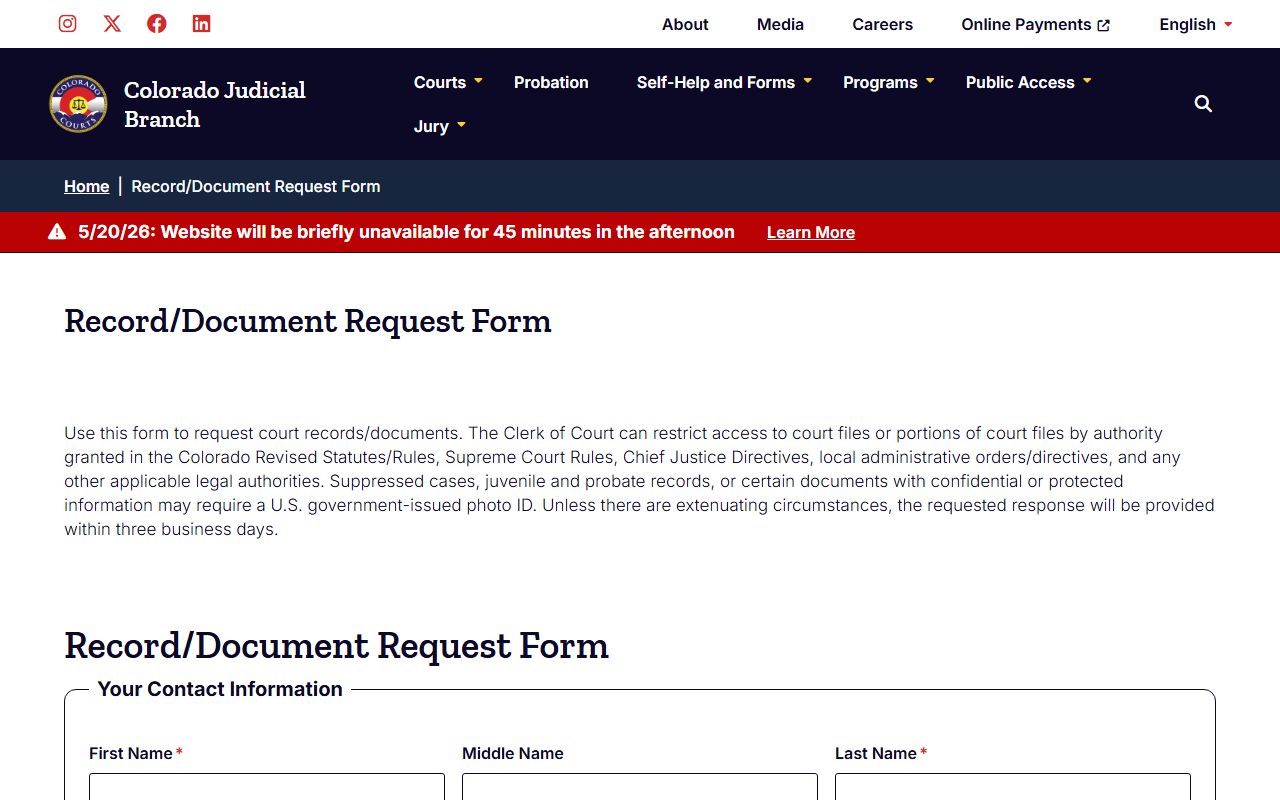
The form has a probate document section with checkboxes for Letters, Will, Trust, Application, Petition, Closing, Claims, and Date of Death. Filing year goes back to 1873 in the dropdown.
- Open Docket Search. Set County to Boulder County, Court Type to District, Case Class to PR, and a date range.
- Add a party name or a case number. The party may be the decedent, the protected person, the ward, the petitioner, or the fiduciary.
- Note the case number in the format 20XXPR##### for the next step.
- Open the Record/Document Request Form. Pick Case Type = Probate and enter the year filed and Boulder County as the location.
- Check the Probate document boxes you need: Letters, Will, Trust, Application, Petition, Closing, Claims, or Date of Death.
- Mark the certified or exemplified box if banks, title companies, real estate offices, or out-of-state courts will use the copy.
Where Probate Cases Are Filed in Boulder County
All Boulder County probate cases are filed in district court at the Boulder County Combined Court. The main building is in Boulder, with a satellite in Longmont. The full Boulder County Combined Court location page lists hours, phone numbers, and after-hours notes for protection order filings, which can also affect interested parties in some probate matters.
The court page is captured below for reference. See the official Boulder County Combined Court page for the source.
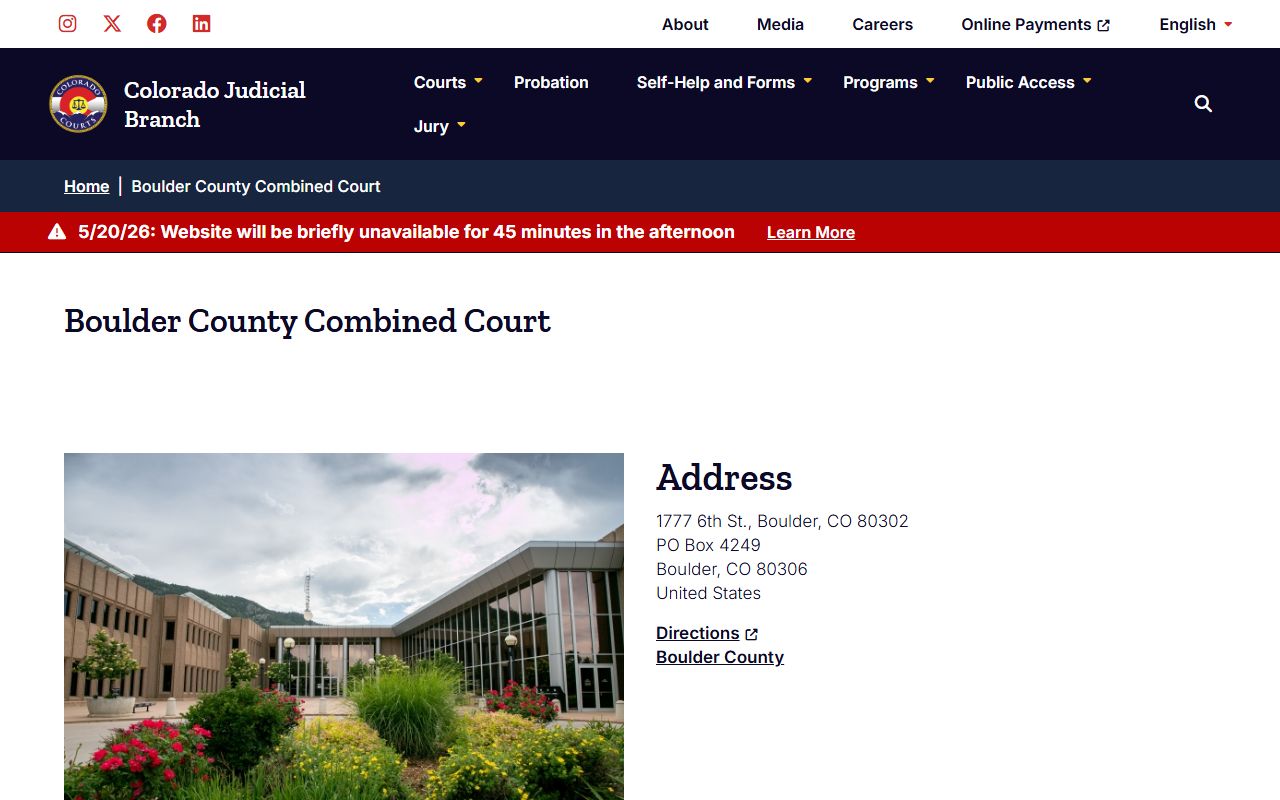
Use the Boulder address for hearings, filings, and walk-in copy requests. Mail goes to the P.O. Box.
Boulder County Combined Court (Probate)
1777 6th St.
Boulder, CO 80302
Mailing: PO Box 4249, Boulder, CO 80306
303-441-3750
Clerk hours: Mon-Fri, 8 a.m.-4 p.m.
Building hours: Mon-Fri, 8 a.m.-5 p.m.
Boulder County Combined Court - Longmont
1035 Kimbark St.
Longmont, CO 80501
720-564-2522
Hours: Mon-Fri, 8 a.m.-noon and 1 p.m.-4 p.m.
Closed noon to 1 p.m. daily
Boulder County Probate Filing Fees
Probate filing fees in Boulder County match the statewide schedule on the Colorado Judicial Branch fee list. The fee depends on the case sub-type, not the county. Small estate filings are cheaper than supervised administrations. Trust actions cost more than a trust registration statement. Copy and certification fees also apply to closing orders, letters, and admitted wills.
| Item | Amount |
|---|---|
| First filing for decedent's estate (not small estate) | $229 |
| Small estate filing | $113 |
| Supervised administration | $198 |
| Guardianship or conservatorship filing | $229 |
| Personal injury settlement (probate) | $229 |
| Petition to accept transfer | $229 |
| Trust registration statement | $198 |
| Trust action | $229 |
| Registration of foreign guardianship/conservatorship | $201 |
| Allowance of claim or contested claim | $198 |
| Deposit of will (C.R.S. 15-12-204) | $18 |
| Demand for notice | $36 |
| Jury demand fee | $231 |
| Public administrator statement, $500 to under $2,000 | $10 |
| Public administrator statement, $2,000 or more | $109 |
| Copy per page | $0.25 |
| Certifying a copy | $20 |
| Exemplification | $20 |
| Name search | $5 |
| Research or redaction after first hour | $30/hour |
Fee waivers may be available for low-income filers; the Court Resource Center can hand out and check the JDF fee waiver paperwork.
What Boulder County Probate Records Show
A Boulder County probate file is the court's running history of the estate, trust, or protected person. Each docket entry adds a layer. The case number takes the form 20XXPR##### and stays with the file for its whole life on the court system. A clean file shows the decedent or ward, the petitioner, the attorney, the filing date, the case status, the appointed fiduciary, and every order signed by the judge. A messy or contested file adds claims, objections, hearings, and accountings.
Documents commonly found in a Boulder County probate case include the application or petition, the original will or a copy if deposited under C.R.S. 15-12-204, letters testamentary or letters of administration, the inventory, accountings if ordered, trust registration statements, claims by creditors, demands for notice, bond paperwork if a bond was set, settlement orders for personal injury cases tied to a minor or estate, closing documents, and final orders of distribution. Hearings show up on the Boulder County court dockets page when set.
- Case number, case class PR, division, and judicial officer.
- Decedent, protected person, or ward name; petitioner or applicant; attorney of record.
- Filing date, case status, and key hearing dates.
- Fiduciary appointment plus any bond or financial conditions set by the court.
- Documents on file: application, petition, will, letters, trust, claims, closing, plus date-of-death notes.
Restricted Boulder County Probate Records
Probate dockets are mostly public, but the file can hold sealed or restricted material. Guardianship and conservatorship cases bring in medical capacity reports and protected-person financial data. Minor settlement files include the child's identifiers. The court keeps those parts out of public view under Colorado Title 15 and Chief Justice Directive 05-01.
The record request form warns that probate records may require a U.S. government-issued photo ID. Some users have to show that ID before they can pick up sealed or limited-access material at the courthouse. The public records page explains how CORA, CCJRA, and the judicial public access rules fit together for Boulder County court files.
Probate Self-Help in Boulder County
The Colorado Judicial Branch Self-Help page hosts the trusts/estates/wills forms used in every Boulder County probate case. Common forms include the application for informal probate, the petition for formal probate, letters, the inventory, the accounting, and the small estate affidavit. Boulder users can also call the local Court Resource Center at 720-664-1505 or email BoulderCourtSelfHelp@judicial.state.co.us. Self-help staff give procedural help and forms, not legal advice.
Probate is technical, and the rules in Title 15 of the Colorado Revised Statutes cover everything from will validity to fiduciary duties. Many filers hire a probate lawyer for contested estates, trust actions, or conservatorships, but pro se filings are common for small estates and informal estates.