
How to Search Boulder County Court Records
The main free tool for a Boulder County court records search is the statewide Colorado Judicial Branch Docket Search. The docket search lists hearings and court events for both Boulder County District Court and Boulder County Court, all within the 20th Judicial District. It does not return case documents and it is not a register of actions. For document copies, the next step is the official record/document request form or an email to 20recordsrequest@judicial.state.co.us. Recorded land, marriage, and lien records sit in a different system run by the Boulder County Clerk & Recorder Recording Division.
Before starting, gather what you know about the case. A case number speeds things up; if not, a party name and a likely year of filing work. Note the court type, because the form requires it. Felony, divorce, probate, juvenile, and larger civil files sit in district court. Misdemeanor, traffic, small claims, and county civil files sit in county court. The Judicial Branch Access Guide to Public Records states case records may also be searched, for a fee, through third-party vendors linked by the state. Those vendors return a register of actions but no court documents, and they are not the official record.
The Colorado Docket Search form is captured below for reference. Each filter narrows the docket list returned for a Boulder court date or range.
The statewide docket search form sets the basic filters every Boulder court records user works with.
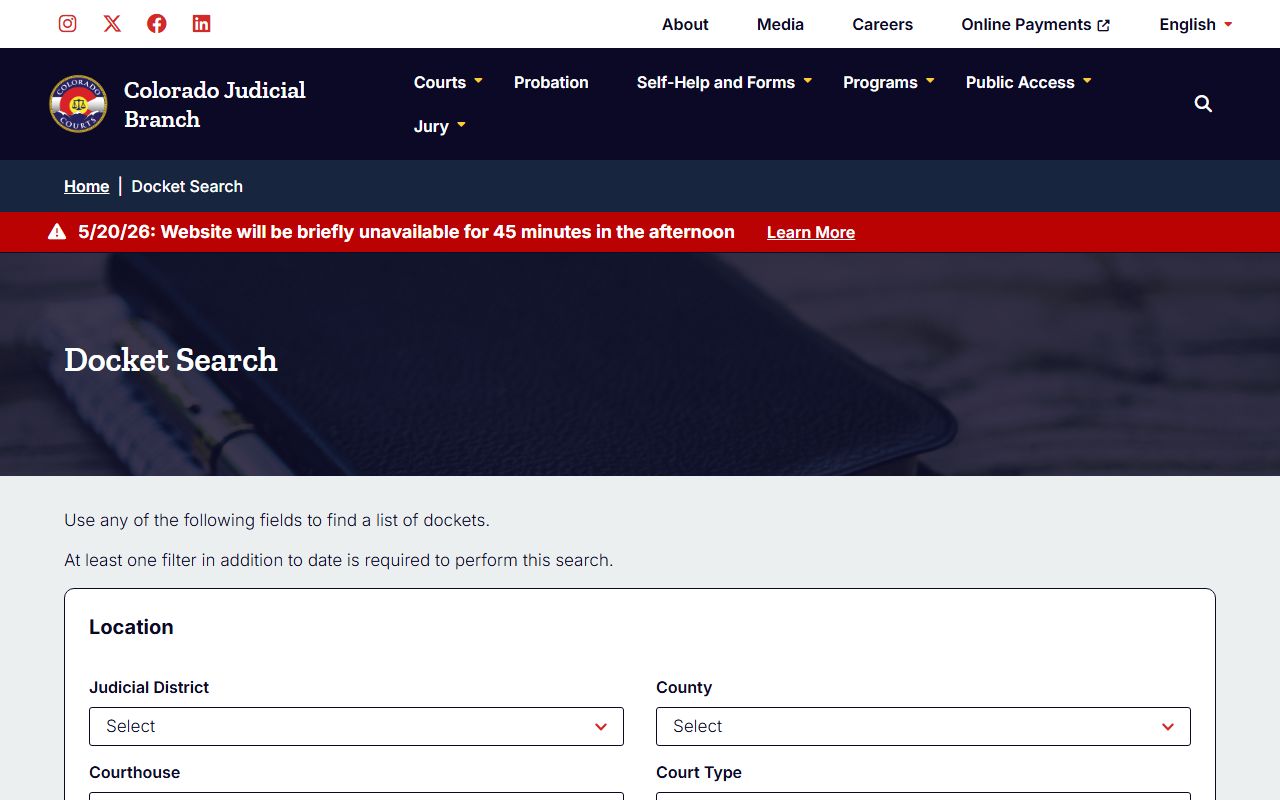
The form requires a date range plus one more filter; selecting Boulder County and a case class is the fastest way to find a hearing.
- Open the Colorado Judicial Branch Docket Search page and read the rule: at least one filter in addition to date is needed.
- Set Judicial District to 20th or set County to Boulder. If you know the courthouse, pick Boulder County Combined Court or Boulder County Combined Court - Longmont.
- Choose Court Type: District for felony, divorce, probate, juvenile, and larger civil; County for misdemeanor, traffic, small claims, and county civil. Use Both if unsure.
- Pick a date range (6 Months, 3 Months, 1 Month, 1 Week, Today, or Specific Date). Add a case class, case number, party name, or attorney name to meet the one-extra-filter rule.
- Review the Docket Search Results. Note the case number, division, court type, and hearing date for use on the next step.
- Submit the online record/document request form for case documents. Add party names, case number, case type, filing year, county location, and the documents you want, such as a divorce decree, sentence order, or transcript of judgment.
- Pay the fees on the Colorado Judicial Branch fee list: copies are $0.25 per single-sided page, certification is $20 per document, name search is $5, and research after the first hour is $30/hour. The court contacts you once the request is processed.
Boulder County Court Records Search Fields
The Colorado Docket Search uses a single form for every county and court type, so the Boulder County court records search fields are the same as the rest of the state. Most fields are optional, but the page warns that "at least one filter in addition to date is required to perform this search." The form groups its filters into five blocks: Location, Date, Case Number, Party, and Attorney. The portal does not return court documents; it returns docket entries for a hearing date or range. For full case file access, users move on to the record request form.
| Field Label | Type | Required | Notes / Format |
|---|---|---|---|
| Judicial District | Dropdown | Optional (one location filter needed) | 1st through 23rd. Boulder County is 20th. |
| County | Dropdown | Optional | Select Boulder County for local results. |
| Courthouse | Dropdown | Optional | Boulder County Combined Court or Boulder County Combined Court - Longmont. |
| Court Type | Dropdown | Optional | Both, County, or District. |
| Division | Text | Optional | Number or letter (e.g., 1-14, J, M, O, T). |
| Date Range | Dropdown | Required date | 6 Months, 3 Months, 1 Month, 1 Week, Today, Specific Date. |
| Specify A Date | Date | Conditional | Used with Specific Date. |
| 4-Digit Year | Text | Optional | Case-number year, e.g., 2024. |
| Case Class | Dropdown | Optional | C, CR, CV, CW, DR, JD, JV, M, PR, R, S, T. |
| Case Sequence | Text | Optional | Sequential number portion. |
| Individual / Business | Radio | Optional | Sets party search mode. |
| First Name | Text | Optional | Party first name. |
| Last Name | Text | Optional | Party last name. |
| Business Name | Text | Optional | Used for business party search. |
| Attorney Bar Number | Text | Optional | Numeric bar number. |
| Attorney First/Last Name | Text | Optional | Used for attorney search mode. |
Case class is the most useful filter for narrowing. CR is district criminal, DR is domestic relations, PR is probate, M is misdemeanor, T is traffic, S is small claims, CV is district civil, and JD/JV cover juvenile matters with public-access limits.
Types of Boulder County Court Records
Boulder County court records come from a single combined court that houses district court, county court, and magistrate divisions. The case class on the docket tells you which file you are looking at and which set of rules controls public access. The 20th Judicial District is coextensive with Boulder County, so every state-court file for a Boulder address routes through the Combined Court at 1777 6th Street or the Longmont satellite at 1035 Kimbark Street. Municipal court cases from cities like Boulder, Longmont, Lafayette, Louisville, and Erie are tracked by each city's own court and are not in the state docket search.
The full list of Boulder County state-court record types is broad. Civil and criminal files are the largest groups, but probate, domestic relations, juvenile, and traffic files all sit in the same docket system.
- Civil court records (CV, C, R): complaints, answers, motions, orders, judgments, writs, garnishments, and satisfactions of judgment.
- Criminal court records (CR, M): felony and misdemeanor files with bond, plea, sentence, and probation entries; arrest reports stay with law enforcement.
- Family/domestic relations records (DR): divorce, legal separation, parental responsibility, support, and protection-order material.
- Probate (PR), juvenile (JD, JV), traffic (T), small claims (S), and water (CW) files, each governed by its own statute and CJD 05-01 limits.
- Eviction (FED), name change, judgment, lien, and Rule 120 foreclosure files; legal postings appear on the Boulder court page.
Protection orders sit in their own track. The Boulder court page tells filers to ring the doorbell at window #1 after 4 p.m. for a Temporary Protection Order, Motion to Restrict, or TERPO/ERPO filing. Name change matters fall under district civil at $268 or county civil at $98, depending on the path used. For divorce records, see the dedicated Boulder County marriage and divorce records page. For traffic citations, see Boulder County traffic court records.
What Boulder County Court Records Show
A Colorado register of actions is a chronological summary of a case. It is not the case file. It lists the events, parties, hearings, orders, and dispositions, but not the underlying documents themselves. The Judicial Branch Access Guide to Public Records notes that vendor-based searches return real-time register-of-action data for civil, civil water, small claims, domestic, felony, misdemeanor, and traffic cases, but that copies of documents must still come from the court of record. The field list below is what most Boulder County court records show when pulled through the official portal or a vendor.
| Field | What It Shows |
|---|---|
| Case Number | Year + case class + sequence, such as 2024CR1234, 2025DR500, or 2026T999999. |
| Case Class | One of C, CR, CV, CW, DR, JD, JV, M, PR, R, S, or T. |
| Court Location | Boulder County Combined Court or Boulder County Combined Court - Longmont. |
| Court Type | District or County. |
| Division | Numeric (1-14) or letter division (J, M, O, T). |
| Judicial Officer | Name of the district judge, county judge, or magistrate. |
| Parties | Plaintiff, defendant, petitioner, respondent, estate, ward, or People of the State of Colorado. |
| Filing Date | Date the case opened in the 20th Judicial District. |
| Hearing Date/Time | Date, time, courtroom, and hearing type for upcoming or past events. |
| Register of Action | Charges, sentences, minute orders, filings, judgments, continuances, and disposition events. |
| Disposition | Outcome of a criminal or juvenile case (plea, dismissal, verdict, sentence). |
| Financial Fields | Fines, restitution, bond, judgment amount, and court costs. |
| Redactions | SSNs, financial account numbers, protected addresses, juvenile identifiers, and sealed material per CJD 05-01. |
| Documents | Not downloadable; copies must be requested from the court. |
For a related on-site view of hearings only, see Boulder County court dockets.
Public Access Framework for Boulder County Court Records
Colorado runs three overlapping public-access regimes. General government files fall under the Colorado Open Records Act (CORA), C.R.S. 24-72-201 to 24-72-206. Criminal justice agency records, including sheriff and DA files, fall under the Colorado Criminal Justice Records Act (CCJRA), C.R.S. 24-72-301 et seq. Court case files are controlled by Chief Justice Directive 05-01 and related statutes and rules. Boulder County government applies CORA through its CORA request page and an Open Records Center.
The Colorado Judicial Branch Access Guide sets out how the three regimes split. The page makes clear that direct online access to case files is not provided by the Judicial Branch (except for dockets), and that documents must be requested by form, mail, email, or in person at the court where the case was filed.
The Colorado Judicial Branch Public Access Guide explains the rules behind every Boulder County court records request.
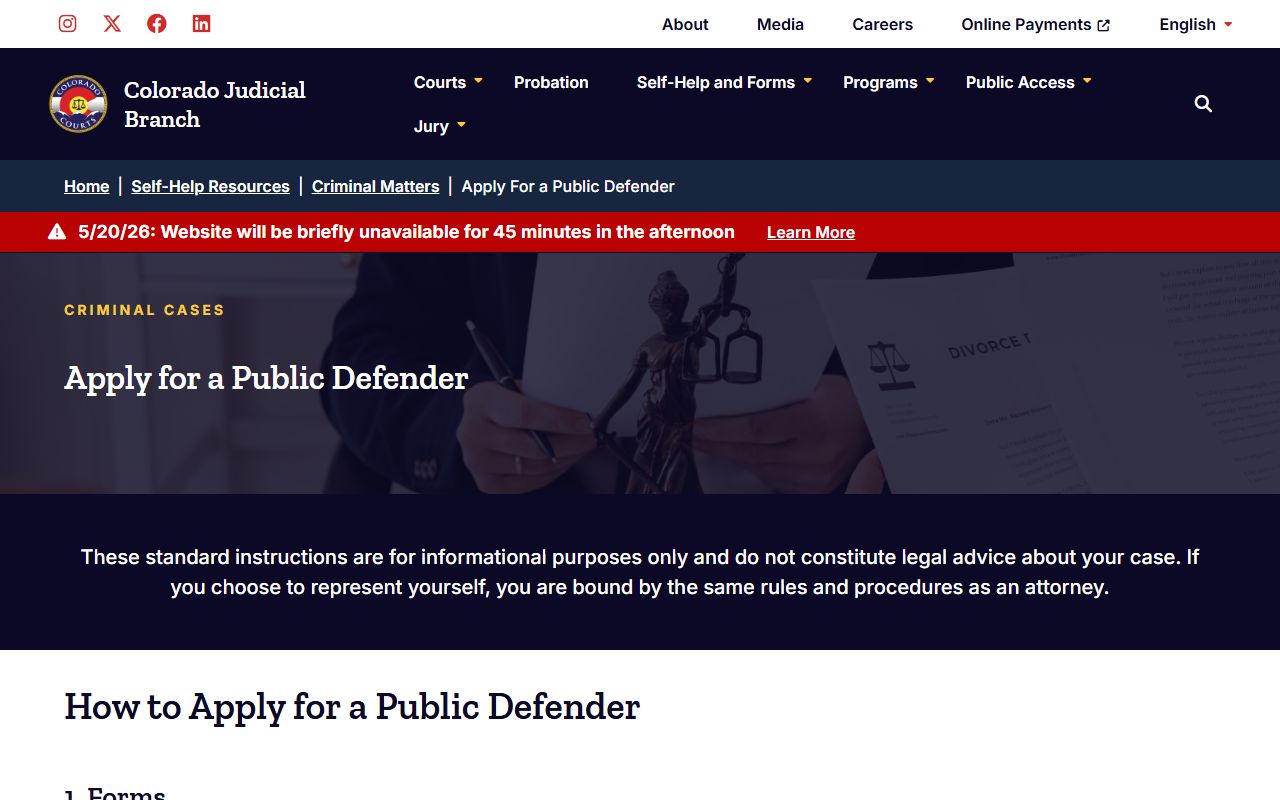
The Access Guide also lists the third-party vendors that the state links for register-of-actions searches.
Anyone can request a Boulder court file, but the request form asks for the requester's name, address, email, and phone. CORA allows fees for staff time, copies, and certain production work under C.R.S. 24-72-205. Response timelines under CORA generally run three working days, with up to seven added working days in extenuating circumstances. The CCJRA gives criminal justice custodians their own rules under C.R.S. 24-72-304 and lets them deny access if release is contrary to the public interest under C.R.S. 24-72-305. For records from Boulder County Sheriff Records, the CCJRA framework usually applies.
Note: Colorado's open records law dates from 1969 and treats government files as open by default unless a specific statute, court rule, or order restricts access.
Records That Are Sealed or Confidential in Boulder County
Some Boulder County court records are not open to a general search. Juvenile delinquency, dependency and neglect, and adoption files are limited under Title 19 and CJD 05-01. Sealed and expunged records are governed by C.R.S. 24-72-703 through 24-72-710. Probate protective proceedings often hold medical, capacity, financial, and minor-related material. Mental health, competency, and treatment files are restricted by statute, HIPAA-adjacent privacy, and court order. Grand jury proceedings are confidential unless an indictment or court order opens them. Sealed warrants and sealed affidavits become public only by statute or order.
Personal identifiers like Social Security numbers, full dates of birth in some contexts, financial account numbers, protected addresses, victim information, and medical data are redacted before release. The record request form warns that suppressed, juvenile, probate, and confidential or protected records may require a U.S. government-issued photo ID or proof of entitlement.
Sealing and expungement work differently in Colorado. Sealing hides a file from ordinary public search but keeps court, law-enforcement, and prosecutor access. Expungement is more common in juvenile matters and removes the file more completely. The Colorado General Assembly's sealing and expunging memo covers the path for criminal records. Successful diversion through the Boulder DA's Center for Prevention and Restorative Justice leads to dismissal and automatic sealing of most arrest and criminal records under Colorado law. Wrong court, ineligible offense, unpaid sentence terms, short waiting period, or a new criminal case can stop a sealing motion.
In-Person and Certified Copy Requests
Walk-in requests are handled at the Boulder County Combined Court Clerk's Office. The clerk window is open Monday through Friday, 8 a.m. to 4 p.m. Bring a photo ID, the case number if known, the party name, and the case type. The research and records department can also be reached by email or phone for case-record questions before a visit.
The online court record and document request form is the most direct path for certified copies and full case files in Boulder County.
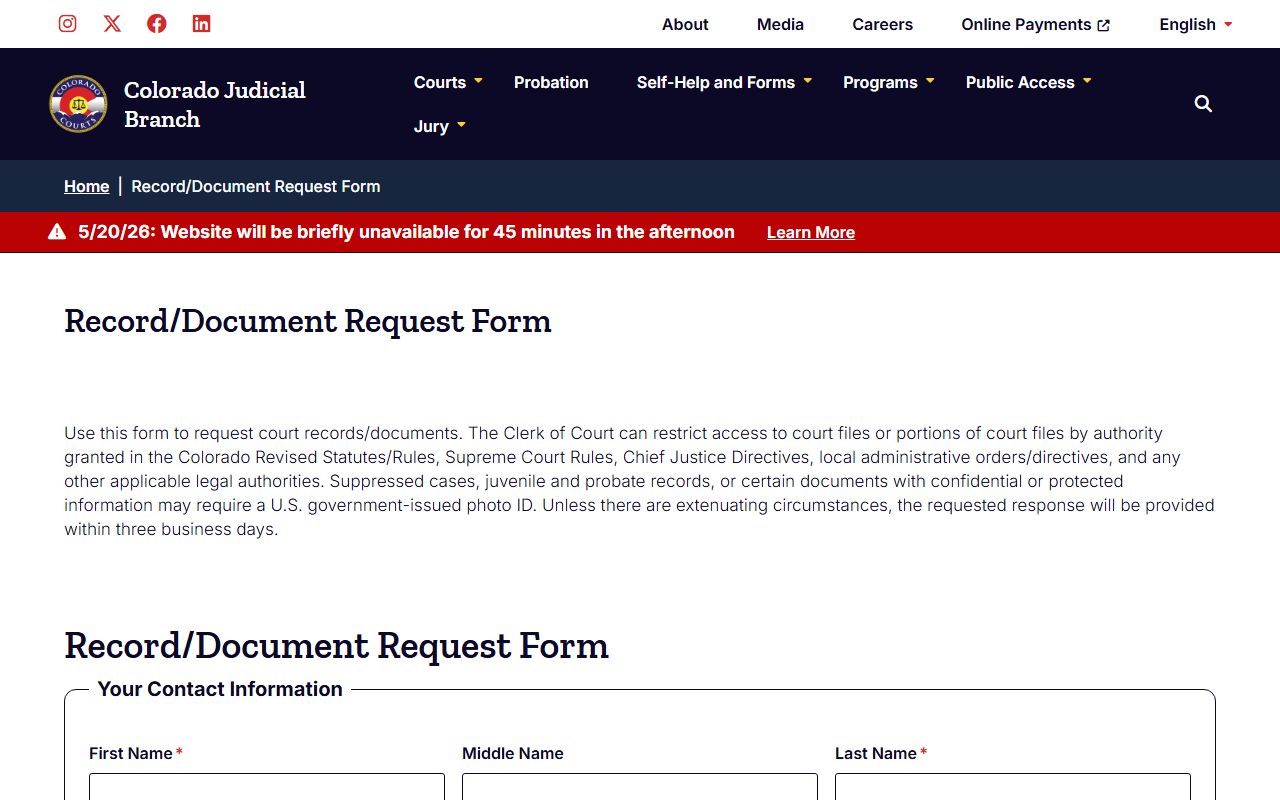
The form lists case class, year, county, party information, and document checkboxes for divorce decrees, sentence orders, transcripts of judgment, wills, letters, and more.
Boulder County Combined Court
1777 6th St.
Boulder, CO 80302
303-441-3750
Clerk hours: Mon-Fri 8 a.m.-4 p.m.
For certified or exemplified copies, the Judicial Branch fee list controls. Copies are $0.25 per single-sided page or $0.50 double-sided, certification is $20 per document, exemplification is $20, a transcript of judgment is $25, a name search is $5, off-site retrieval is at actual cost, and research/redaction after the first hour is $30 per hour in 15-minute increments. Mail requests go to Clerk of Court, PO Box 4249, Boulder, CO 80306. The Longmont satellite at 1035 Kimbark Street handles Longmont-side cases and is closed from noon to 1 p.m.
Third-Party Vendor Searches: What to Know
Some private vendors carry a real-time register of actions for Colorado state cases. The Colorado Judicial Branch Access Guide lists them: Background Information Services, LexisNexis/CoCourts, and Tessera Data. These are not the official court record. They charge fees, do not provide court documents, and pull from the same Judicial Department electronic database used for the docket search. The Access Guide warns that information may not represent all cases or all case types and that anyone who believes data is wrong should contact the court where the original record was created or filed.
The site you are on is not affiliated with any court or government agency. Use it as a starting point for keywords and source links, then confirm any case detail against the official Colorado Judicial Branch docket, the record request form, or the Boulder County Clerk of Court page.