
Criminal Records in Boulder County
Three local offices create the bulk of Boulder County criminal records. The Sheriff's Office books people into the Boulder County Jail at 3200 Airport Road and writes the arrest report. City police agencies in Boulder, Longmont, Louisville, Lafayette, Erie, and the smaller towns make many of the arrests that feed the jail. The Clerk of Court at the Boulder County Combined Court opens the case file once charges are filed. The 20th Judicial District Attorney, Michael Dougherty, decides whether to charge a felony in District Court, a misdemeanor in County Court, or to route the matter into the Center for Prevention and Restorative Justice for diversion.
An arrest record and a criminal court record are not the same thing. The arrest record is the booking entry: name, agency, charges at booking, booking date, and the photo. The court record begins when the People of the State of Colorado file a complaint or information. That file holds the formal charges, bond paperwork, motions, plea entries, sentencing orders, probation terms, and the final disposition. A conviction record is narrower still. It is the part of the court file that shows a guilty plea or a guilty verdict, plus the sentence. Many Boulder arrests never end in a conviction. Some end in dismissal, deferred judgment, acquittal, or diversion with a sealed file.
How to Search Boulder County Criminal Records
The main free path is the Colorado Judicial Branch statewide Docket Search. It lists hearings for the Boulder County Combined Court and the Longmont satellite, but it does not show document images. For booking photos or full reports, the request goes to the Sheriff's Records Section. For sealed cases, the court must verify status before any file is released.
The Sheriff's Records page lays out fees and what the Records Section keeps on file. Source: Boulder County Sheriff Records Section.
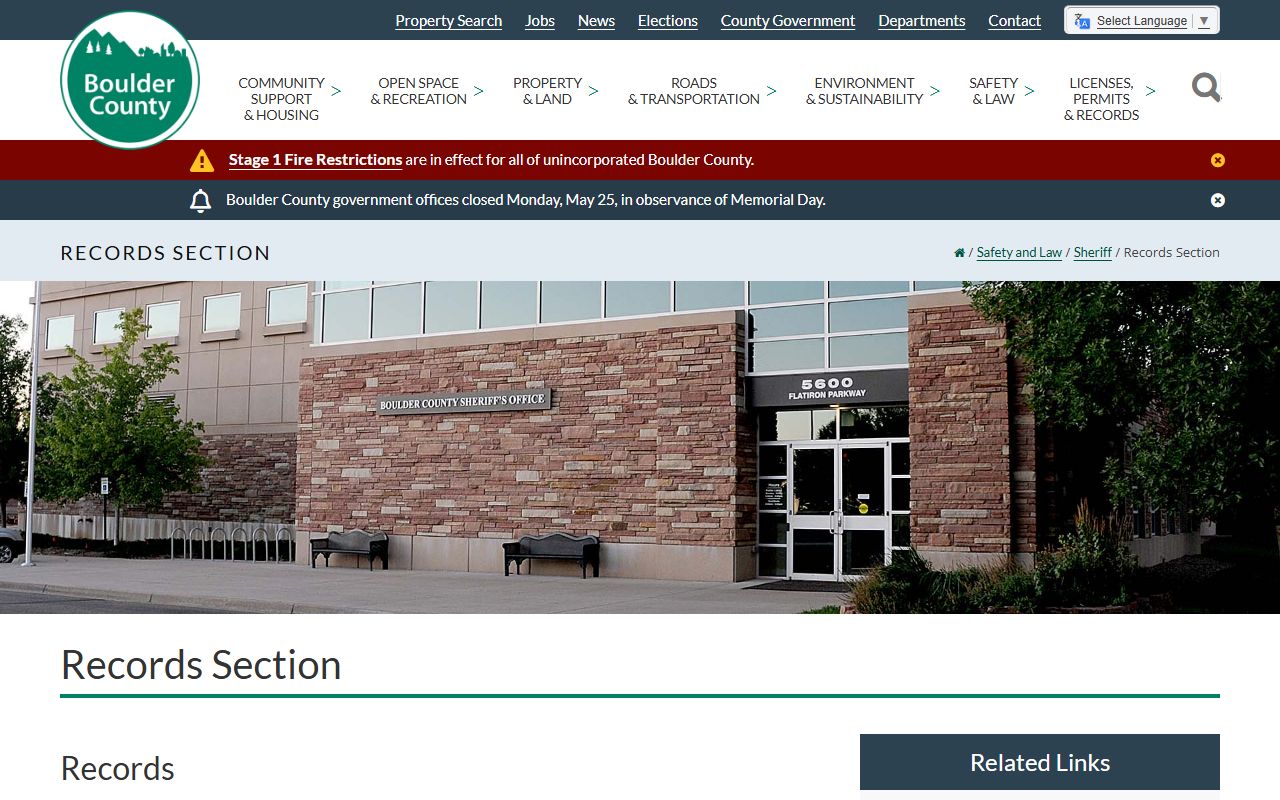
The Records page is where requests for arrest photos, jail records, and dispatch recordings start. Search fees run $5 for each searched report covering up to 10 pages. Pages over 10 cost $0.25 each. Fees are waived for anyone listed as a victim.
- Open the statewide Docket Search. Pick Boulder County. Set Court Type to Both, or to District for felony and to County for misdemeanor.
- Pick a date range. The portal needs one filter on top of the date.
- If the case number is known, enter the 4-digit year, the case class (CR for felony, M for misdemeanor), and the sequence. Example: 2024CR1234.
- If only a name is known, use the Individual Party search with first and last name plus Boulder County.
- For a booking photo, current charges at booking, or an arrest report, file a Records Request with the Sheriff or call 303-441-3600.
- For court documents, use the online Record Request Form or email 20recordsrequest@judicial.state.co.us with the case number and case class.
- Confirm the disposition before treating anyone as convicted. A pending case is still a charge, not a conviction.
For a statewide criminal-history check, Colorado uses the CBI Computerized Criminal History (CCH) name search. The CBI fee is $6.85 per name. CCH does not pull sealed files. Sealed cases need a court order or status check at the court that issued the seal.
Docket Search Fields for Criminal Cases
The statewide docket portal uses the same form for all case types, but only a few fields matter for a criminal lookup. Use the case class field to filter to CR or M.
| Field | Type | Notes for Criminal Search |
|---|---|---|
| Judicial District | dropdown | Pick 20th Judicial District for Boulder. |
| County | dropdown | Pick Boulder County. |
| Courthouse | dropdown | Boulder County Combined Court or Boulder County Combined Court - Longmont. |
| Court Type | dropdown | District for felony CR. County for misdemeanor M. |
| Case Class | dropdown | Pick CR for felony, M for misdemeanor, JD for juvenile delinquency. |
| 4-Digit Year | text | Year the case was filed, e.g., 2024. |
| Case Sequence | text | Numeric sequence after the class, e.g., 1234. |
| Date Range | dropdown | One date filter is required. Pick a span up to 6 months. |
| Party Name | text | Individual first and last name, or business name. |
The portal warns that at least one filter besides the date must be set. Case classes CR and M are the two that show up most often on a Boulder County criminal search.
Arrest Records vs. Criminal Court Records
An arrest takes place at booking. The court record only starts when the District Attorney files charges. The two files live in different places, with different rules and different fees.
| Arrest Record | Criminal Court Record | |
|---|---|---|
| Source | Sheriff or local police | Clerk of the Combined Court |
| Created When | Booking at the jail | Charges filed by the DA |
| Case Class Prefix | Booking number, agency number | CR (felony) or M (misdemeanor) |
| Contents | Booking info, charges at booking, mugshot, agency | Pleadings, motions, plea, sentence, disposition |
| How to Request | Sheriff Records Request, 303-441-3600 | Online Record Request Form or 20recordsrequest@judicial.state.co.us |
| Public by Default | Yes for adults, subject to CCJRA | Yes, with CJD 05-01 redactions |
Charges vs. Convictions
A charge is an accusation. A conviction is a verdict or a plea that the court has entered. Treating the two as the same is the single most common error in casual record lookups. Use the disposition entry on the register of actions to tell them apart.
| Charge | Conviction | |
|---|---|---|
| Stage | Accusation by the DA | Guilty plea or guilty verdict |
| Burden of Proof | Probable cause | Beyond a reasonable doubt |
| Filed By | 20th Judicial District Attorney | Court order after plea or trial |
| Public Record | Yes, on the docket | Yes, on the disposition entry |
| Effect | Bond, court dates, conditions | Sentence, fine, probation, jail, prison |
| Sealable | Often yes on dismissal | Limited by C.R.S. 24-72-706 |
Sealed vs. Expunged Records
Colorado separates sealing from expungement, and the words are not interchangeable. Sealing hides a file from ordinary public view, but courts, law enforcement, prosecutors, and some agencies keep access. Expungement is mostly a juvenile remedy and treats the record as if it never existed. The Colorado General Assembly publishes a current overview of the sealing and expunging process.
| Sealed | Expunged | |
|---|---|---|
| Visibility | Hidden from public docket | Treated as never existed |
| Law Enforcement | Still accessible | Very limited access |
| Common Use | Adult arrests, non-convictions, some convictions | Juvenile records under Title 19 |
| Authority | C.R.S. 24-72-703 to 706 | C.R.S. Title 19 |
| Auto Trigger | Successful pretrial diversion | Successful juvenile completion |
| Background Checks | Hidden from most employers | Hidden from nearly all checks |
The Boulder County DA's diversion page states that most youth and adult arrest or criminal records are automatically sealed under Colorado law after a successful pretrial diversion. Courts, law enforcement, and certain governmental agencies can still see them. Source: Boulder DA Diversion.
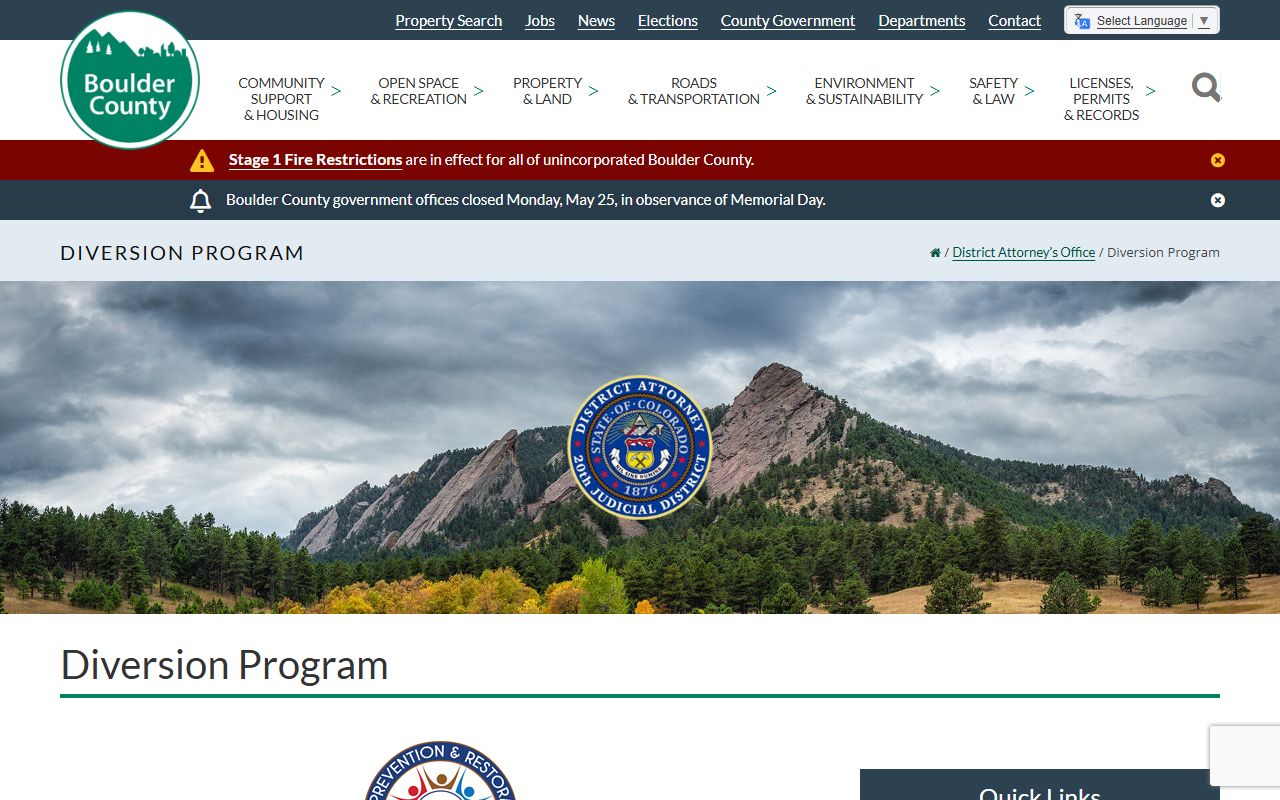
Diversion typically runs four to twelve months. On completion, the case is dismissed and the auto-seal applies in most adult and youth files. Excluded offenses, traffic items like DUI, sex offenses, and victim-rights crimes may not qualify.
Mugshots and Booking Photos
Booking photos do not appear on the public Daily Booking and Listing Reports by default. The October 30, 2024 county news release said the enhanced page added name search, a same-day release report, current population data, and historical jail statistics, but mugshots were kept off the public dashboard. The official notice points anyone who wants a mugshot to a Records Request or to the Records Division at 303-441-3600.
Adult mugshots are released under the Colorado Criminal Justice Records Act, C.R.S. 24-72-301 to 24-72-309. Juvenile arrest photos cannot be released unless the juvenile is charged as an adult. The Records Section also keeps fingerprint records and dispatch recordings under the same fee schedule.
20th Judicial District Attorney and Public Defender
Michael Dougherty is the 20th Judicial District Attorney for Boulder County. The DA's office charges state criminal cases, runs grand jury work, oversees victim services, and operates the Center for Prevention and Restorative Justice. Source: Boulder County District Attorney.
The DA office is the first stop for press contacts, victim-impact statements, and restitution questions. Media contact is Shannon Carbone, scarbone@bouldercounty.gov, 303-441-3804.
The Colorado State Public Defender Boulder office sits at 2555 55th Street, Suite D-200, Boulder, CO 80301. Phone: 303-444-2322. Office Head: Nicole Collins. To apply for a court-appointed defender, adults complete JDF 208, the Request for a State Paid Professional. The form can be filed by email or in person at any public defender office.
Walk-In Warrant Procedures
The Boulder County court page includes a Walk-In Warrant Information section. It is meant to let defendants with active warrants get the case added to the docket without a fresh arrest. Members of the public must call Boulder County Courts at 303-441-3750 or appear in person at a police department or the Sheriff's Office with a photo ID to ask about a warrant. The Sheriff does not publish a public active-warrant list.
If a warrant exists in a pending Boulder case, the 20th Judicial District Walk-In Warrant Procedures explain when and how to appear. Victim-Rights Act crimes are not eligible for walk-in. For more on outstanding warrants, see Boulder County warrant records.
Boulder County Sex Offender Registry
The county directs sex-offender lookups to the Colorado Bureau of Investigation. Boulder County keeps a short explainer at the county sex offender registry page. The live search runs on the state CBI system at the CBI sex offender registry agreement page.
The CBI registry covers adult felony registrants posted under Colorado law. The CBI Sex Offender Registration Unit warns that not every Colorado registrant appears on the public site. Misdemeanor registrants and juvenile adjudication registrants are kept off the public roster. Source: CBI Sex Offender Registration Unit.
The public search lets users filter by first name, last name, city, county (pick Boulder), or ZIP code. A user must accept the use-restriction warning before the search loads. The profile pages typically show name and aliases, a photograph where available, current registration address, the offense that triggered registration, date of offense or conviction, and a physical description.
Statewide Criminal History Search
The Colorado Bureau of Investigation runs the official statewide Computerized Criminal History. The CCH name search fee is $6.85 per name. The CCH report covers Colorado arrests and dispositions reported to CBI. It does not include sealed cases, federal cases, or out-of-state criminal history. For a full multi-state picture, a fingerprint-based check is more reliable than a name-only CCH.
Other statewide reference points include the Colorado Department of Corrections inmate locator for people sentenced to state prison and the federal Bureau of Prisons locator for federal sentences. Boulder County jail custody and DOC custody are separate events. A Boulder release does not always mean the person is free; the case may have routed into prison or supervised parole.
Background Check Considerations
An FCRA-regulated background check is not the same as a casual record lookup. Employers, landlords, and insurers must use a consumer reporting agency that follows the Fair Credit Reporting Act. The CRA must give the subject notice, get written consent, and follow adverse-action rules. A free docket search or a Records Request to the Sheriff is fine for personal use, but it cannot be used to deny a job, an apartment, or insurance.
Important: Boulder County Court Records is not a consumer reporting agency under the FCRA. Data on this site may not be used for credit, employment, tenant, or insurance decisions.
Restricted Criminal Records in Boulder County
Several types of Boulder criminal files are kept out of ordinary public view. Juvenile delinquency files (case class JD) sit under C.R.S. 19-1-304 and CJD 05-01. Most juvenile case detail is not public. Sealed adult files under C.R.S. 24-72-703 are hidden from public docket entries but remain visible to courts and law enforcement. Open investigations may be withheld under C.R.S. 24-72-305 when release would harm an active case. Search-warrant affidavits can be sealed during the early investigation phase. Mental-health, competency, and protected-victim information are redacted under court rule and statute.
Title 16 of the Colorado Revised Statutes covers arrest and search-warrant procedure and the broader criminal-procedure framework. See C.R.S. Title 16 and C.R.S. Title 18 for the substantive criminal code. The Judicial Branch publishes an Access Guide to Public Records that walks through CJD 05-01 and the role of the court custodian.