
Colorado Open Records Laws That Shape Boulder County Access
Colorado does not use one single records law. Boulder County public records sit under several overlapping regimes. General Boulder County government files fall under the Colorado Open Records Act, C.R.S. 24-72-201 to 24-72-206, often called CORA. Boulder County records held by police, the Sheriff, the DA, and other criminal justice agencies fall under the Colorado Criminal Justice Records Act, C.R.S. 24-72-301 et seq., known as CCJRA. Boulder County court case files are governed by Chief Justice Directive CJD 05-01. Boulder County judicial administrative files are governed by Colorado Supreme Court Chapter 38 Rule 2, also called P.A.I.R.R. 2.
CORA was first enacted in 1969 and starts from the rule that Boulder County public records should be open unless a law restricts access. Any person can ask. The requester does not have to be a Colorado resident, does not have to give a reason, and does not have to be a party to the Boulder County case. A public record is broadly any writing made, kept, or held by a public agency. Boulder County applies CORA through department and elected-official custodians, and the county directs all Boulder County records requests to its Open Records Center as the central front door.
What Boulder County Records Are Available to the Public
Boulder County records split between the Clerk & Recorder, the courts, and other county custodians. The Boulder County Clerk & Recorder's Recording Division holds land and license files going back to 1860. Boulder County court case files are kept by the Clerk of Court at the Boulder and Longmont courthouses. The Boulder County DA, Sheriff, Assessor, and Treasurer each act as a Boulder County custodian for their own files.
- Recorded land documents: deeds, liens, plats, mining claims, foreclosure documents, covenants, assignments, amendments, and UCC filings.
- Recorded license records: marriage and civil union licenses on file with the Recording Division.
- Court case files: civil, criminal, traffic, small claims, domestic relations, probate, and protection orders.
- Sheriff and jail files: daily booking and listing reports, arrest reports, jail records, dispatch recordings.
- DA files: press releases, charging info, diversion program data, and general office records subject to CCJRA limits.
For court case files, see court records. For deeds, liens, and license records, see the Clerk of Court page. For arrest data, the criminal records page covers Sheriff and police sources, and the marriage and divorce records page covers vital-style files held in Boulder County.
Boulder County Open Records Center and CORA Custodians
Boulder County uses an Open Records Center as the main intake point for Boulder County CORA requests. Each elected Boulder County office and department has a designated custodian, and the Open Records Center routes the request to the right Boulder County custodian. Source: Boulder County CORA page. The page also tells the public to first check existing online sources, since many files are already posted.
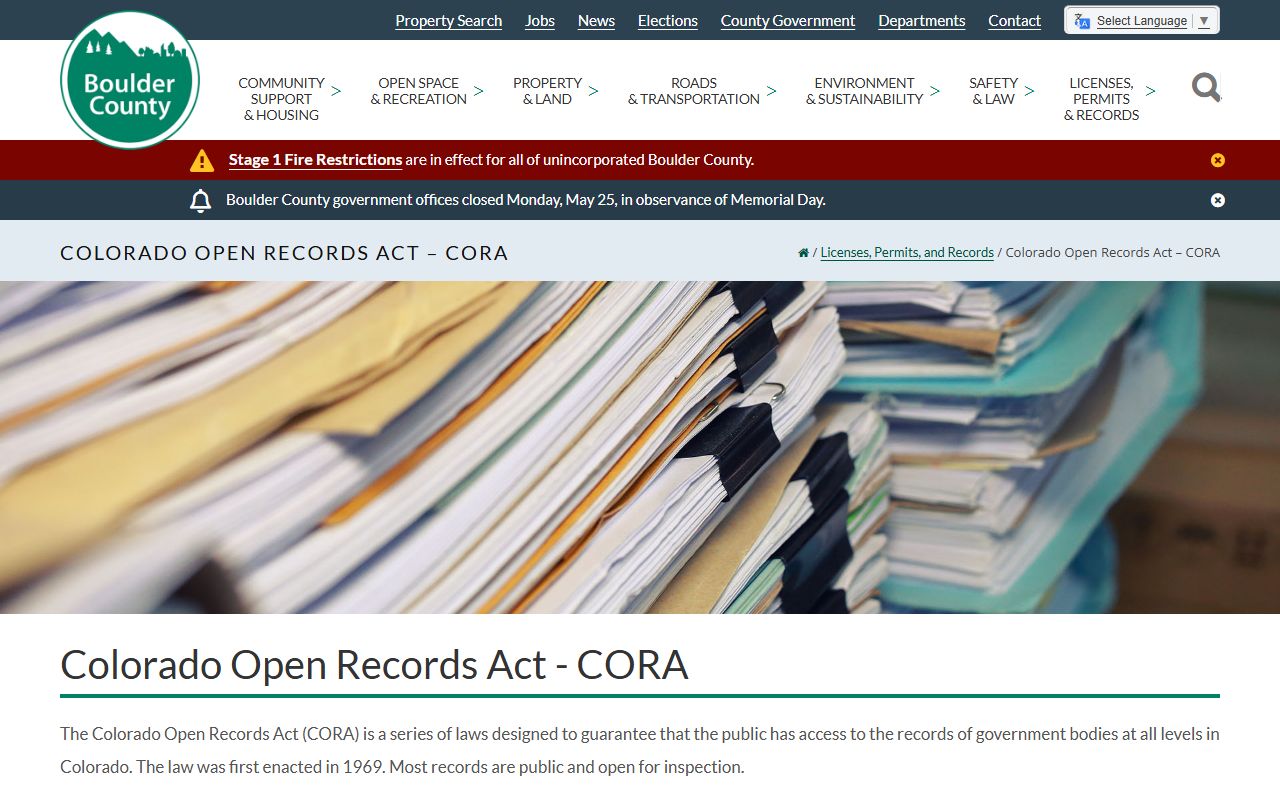
The CORA page lists the Open Records Center, the steps for filing, and links to other Boulder County public records resources. The Clerk & Recorder office page at bouldercounty.gov/departments/clerk-and-recorder lists Molly Fitzpatrick as Clerk & Recorder and links the Recording, Motor Vehicle, and Elections divisions.
How to File a Boulder County Public Records Request
Most Boulder County CORA requests can be filed online, by email, or by mail to the right Boulder County custodian. Boulder County asks requesters to be as specific as possible. A short, narrow request is easier for Boulder County staff to fill and costs less in labor.
- Check existing online sources first. Try the Recording Division public search, the Judicial Branch access guide, or the DA public information page. Many files are already posted.
- Identify the right Boulder County custodian. Courts, Sheriff, DA, Clerk & Recorder, Assessor, and Treasurer each keep their own files. Boulder County CORA goes to the county custodian; CCJRA goes to the Boulder County Sheriff or DA; court files go to the Clerk of Court.
- Submit a CORA request through the Boulder County Open Records Center. Use the form on the CORA page. Court files use the statewide Record/Document Request Form.
- Wait for an acknowledgement. The custodian confirms receipt and may ask for ID or more detail.
- Pay any fees. Labor charges, copy fees, and certified copy fees may apply. Fees must be paid before files are released.
- Receive the records or a written denial. If denied, you can ask for a written reason and may appeal in court.
Court Record Request Form Fields
The state Record/Document Request Form is the most-used form for Boulder County court files. It is the documented Boulder County form for case files in the 20th Judicial District. The table lists the Boulder County form fields and whether the form marks each as required.
| Field | Required | Notes |
|---|---|---|
| First Name | Yes | Requester's first name. |
| Last Name | Yes | Requester's last name. |
| Business Name | No | Use if filing for a firm or office. |
| Yes | Contact email for the requester. | |
| Phone Number | Yes | Contact phone for the requester. |
| Address Line 1, City, State, Zip | Yes | Mailing address; required by the form. |
| Case Number | Optional | Example: 2019T999999. |
| Case Type | Optional | Civil, Divorce, Felony, Juvenile, Misdemeanor, Probate, Protection Order, Small Claims, Traffic, Water. |
| Year Case Was Filed | Optional | Dropdown from 1873 to current year. |
| County / Location of Record | Optional | Select Boulder; a "don't know county" checkbox is available. |
| Date of Birth | Optional | MM/DD/YYYY of the primary party. |
| Party Information | Yes | Names on the case; required field. |
| Family Matters documents | Optional | Decree, Parenting Plan, Separation Agreement, Support Order, Petition. |
| Criminal Matters documents | Optional | Complaint/Information, Disposition/Sentence Order, Protection Order, Ticket. |
| Civil Matters documents | Optional | Order for Judgment, Transcript of Judgment, Satisfaction of Judgment, Protection order. |
| Probate documents | Optional | Letters, Will, Trust, Application, Petition, Closing, Claims, Date of Death. |
| Certified / exemplified | Optional | Check if certified or exemplified copies are needed. |
| CAPTCHA | Yes | Spam check before submit. |
Response Timelines Under CORA
Under C.R.S. 24-72-203, a Boulder County custodian must make records open at reasonable times. Boulder County agency practice is to respond within three working days. The law allows up to seven added working days for extenuating circumstances, such as a large request, off-site Boulder County files, or the need to redact protected data. The Boulder County custodian must give the requester written notice when extending the deadline. CCJRA gives Boulder County criminal justice agencies their own rules under C.R.S. 24-72-304, and CJD 05-01 controls Boulder County court records, so timelines can vary by office.
Recording Division Public Search for Land and License Files
The Boulder County Recording Division at 1750 33rd St., Suite 201, Boulder, holds recorded Boulder County documents back to 1860. Source: Recording Division public search. Free watermarked Boulder County images are available; non-watermarked copies can be ordered for a small fee.
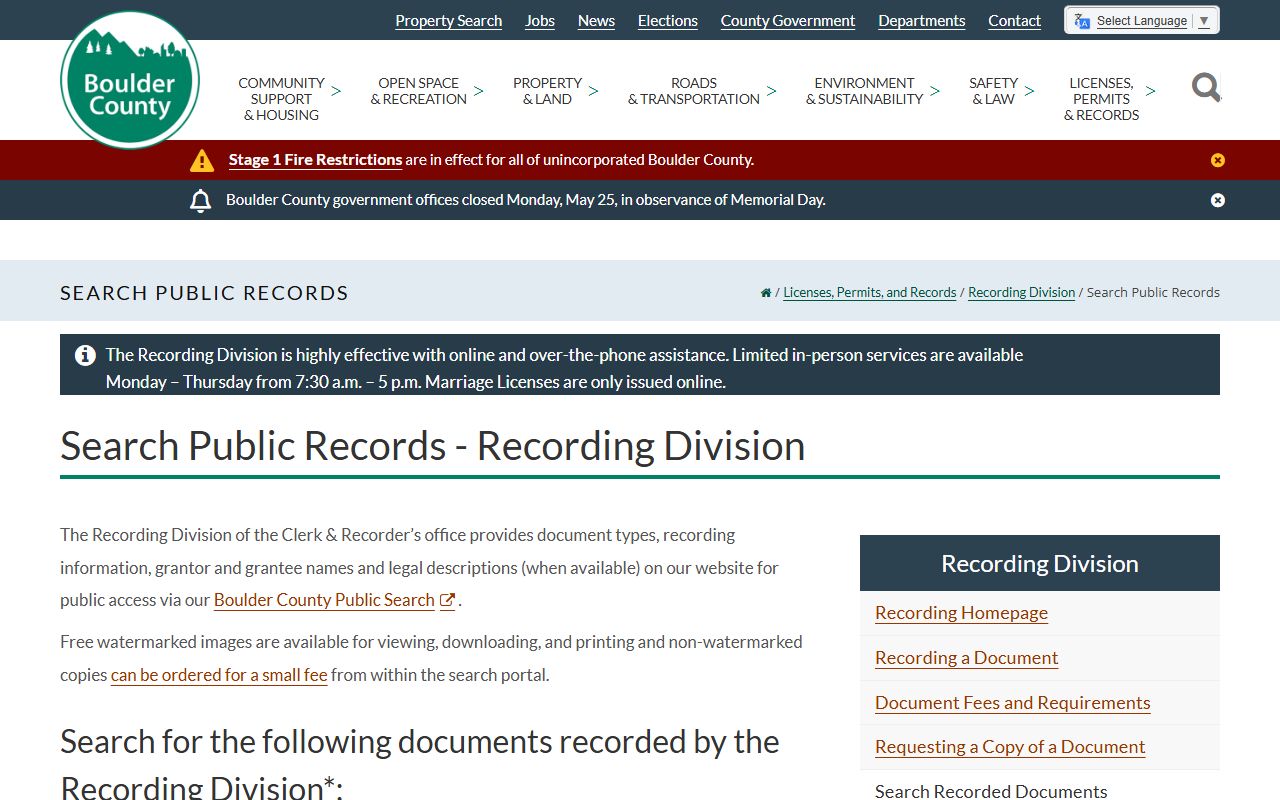
The portal lets users search by name, date, document type, and legal description. Categories include deeds, liens, plats and maps, mining claims, foreclosure docs, marriage and civil union licenses, and UCCs. The Recording FAQ at bouldercounty.gov/records/recording covers margin rules, payee rules for checks, and the documentary fee. Recording Division phone is 303-413-7770; email is recording@bouldercounty.gov; hours are 7:30 a.m. to 5:00 p.m., Monday through Thursday, closed Fridays.
Boulder County Public Records Fees
Boulder County fees split by which office holds the file. Court copy fees are set by the Colorado Judicial Branch. Boulder County recording fees are set by the Clerk & Recorder under Colorado law. Boulder County CORA agencies may charge for staff labor and copies under C.R.S. 24-72-205. The table below covers the most common Boulder County items. Some Boulder County agencies set their own per-hour labor rate.
| Item | Amount |
|---|---|
| Court copy, single-sided per page | $0.25 |
| Court copy, double-sided per page | $0.50 |
| Certifying a court copy | $20 |
| Exemplification | $20 |
| Court name search | $5 |
| Court research / redaction labor after first hour | $30 / hour |
| Recording Division recording fee per document | $43 |
| Recording Division non-digital copy per page | $0.25 |
| Certifying a recorded document | $1 |
| Certified copy of marriage license | $1.25 |
The Judicial Branch fee schedule supports these court fees under C.R.S. 13-32-104. Recording fees took effect July 1, 2025. CORA labor fees may not exceed the statutory cap; the first hour is often free, with later hours billed.
District Attorney Public Records
The Boulder County 20th Judicial District DA keeps its own public records page at bouldercounty.gov/district-attorney/public-opinion-and-media. The Boulder County DA page lists press releases, media contacts, and open records links. Boulder County DA files fall under CCJRA more often than CORA. Charging decisions, case data, and diversion data may be released when the Boulder County office finds release is not contrary to the public interest. The Boulder County DA's Center for Prevention and Restorative Justice handles diversion; most youth and adult arrest and criminal records are automatically sealed after successful pretrial diversion.
Court Records vs Administrative Records
The Colorado Judicial Branch draws a line between Boulder County case records and Boulder County administrative records. Case records are filings and orders in a specific Boulder County case. They follow CJD 05-01. Administrative records are files the Judicial Department keeps to run itself, such as budget files, personnel files, and policy files. They follow P.A.I.R.R. 2 / Colorado Supreme Court Chapter 38 Rule 2. The two rules use different access tests and different timelines. Boulder County court file requests go to the Clerk of Court, while administrative file requests go to the Judicial Department's records officer. See the court records and court dockets pages for case-level lookups.
Restricted and Confidential Boulder County Records
Some Boulder County files are not public. Boulder County restrictions come from CORA denial grounds in C.R.S. 24-72-204, CCJRA grounds in C.R.S. 24-72-305, juvenile rules in Title 19, and sealing rules in C.R.S. 24-72-703 to 706. Common restricted Boulder County categories include juvenile delinquency files, sealed adult criminal files, mental health and competency files, adoption records, grand jury material, sealed search warrants, and victim identifying info. Boulder County probate guardianship files may have docket-level data open while medical and capacity material stays sealed. For the sealing path, see the Colorado Legislature memo at leg.colorado.gov. For sealed and restricted family files, the marriage and divorce records page covers the privacy rules; the probate records page covers protective-proceeding limits.
If a Boulder County Public Records Request Is Denied
If a Boulder County custodian denies a request, ask for the denial in writing and a citation to the law that supports the denial. Under CORA, a Boulder County requester may file a civil suit in district court to compel release. The Boulder County court can order the file produced and may award costs and reasonable attorney fees if the denial was found to be unjust. Boulder County CCJRA cases follow a similar civil-suit path. The Colorado Attorney General's office does not act as a records appeal board, so the Boulder County district court route is the main escalation. For Boulder County court file denials under CJD 05-01, the next step is to ask the court for an order setting access.