
Active Warrants in Boulder County
Active warrants in Boulder County are issued by the 20th Judicial District. The Sheriff's contact directory says the Warrants function handles all warrants from district, county, and civil courts within Boulder County. The public does not get a live arrest-warrant list. Instead, the Sheriff tells people to call Boulder County Courts at 303-441-3750 or to go in person to a police department or the Sheriff's Office with a photo ID. Extradition lines at 303-441-3644 and 303-441-3657 are for law enforcement only.
Most warrant data flows into the court file as part of a case. Bench warrants for failure to appear, failure to comply, or contempt show up on the court docket. Arrest warrants tied to a new criminal case sit in the case record with bond and charge fields. Search warrants and their affidavits may be sealed during an open investigation. The court file is the main route to confirm an active warrant. The 20th Judicial District uses the statewide Colorado Judicial Docket Search, which is free and is updated from the live court system. The Sheriff's Records Section handles older arrest reports and Sheriff-held warrant data through a records request.
For broader context on the 20th Judicial District court, see the official Boulder County trial court page. For court files and case lookups, see Boulder court records and court dockets.
Types of Warrants in Boulder County
Boulder County warrants fall into a few main groups. Each type has its own issuing path, its own service rules, and its own public-access rules. A bench warrant looks different from a sealed search warrant, and a federal warrant runs through the U.S. Marshals.
- Arrest warrant - authorizes law enforcement to take a person into custody on a new criminal charge.
- Bench warrant - issued by a judge, most often for failure to appear, failure to comply, or contempt.
- Search warrant - authorizes the search or seizure of property or data; the affidavit may be sealed during an open case.
- Fugitive or extradition warrant - used for out-of-county or out-of-state custody transfer.
- Federal warrant - issued by the U.S. District Court for the District of Colorado; served by the U.S. Marshals Service.
The Sheriff's civil section also handles non-criminal court paper. That work covers summonses, subpoenas, court orders, writs of execution, garnishments, and restitution or eviction orders. These are not arrest warrants, but they share part of the same workflow and the same office.
How to Search Boulder County Warrants
Two official routes cover most needs. The court Docket Search at coloradojudicial.gov/dockets finds court hearings and pending case events tied to a warrant. A call to Boulder County Courts at 303-441-3750 or an in-person visit with a photo ID to a police department or the Sheriff's Office is the only way to confirm a live active-warrant status from the Sheriff side. Lead with one of the official paths below.
- Open the Colorado Judicial Docket Search and pick Boulder County in the County filter.
- Add a date range and either a party name, a case class, or a case number to meet the one-filter-plus-date rule.
- Scan the docket result for hearing types tied to warrants, such as bench warrant settings or first appearances.
- For a Sheriff-side confirmation, call Boulder County Courts at 303-441-3750 with the full name and date of birth ready.
- Or appear in person at a police department or the Sheriff's Office with a U.S. photo ID and ask about a warrant on file.
- For older arrest or Sheriff-held data, file a records request at the Sheriff's Records page.
An overview of the Sheriff's contact paths is on the official Sheriff contact directory.
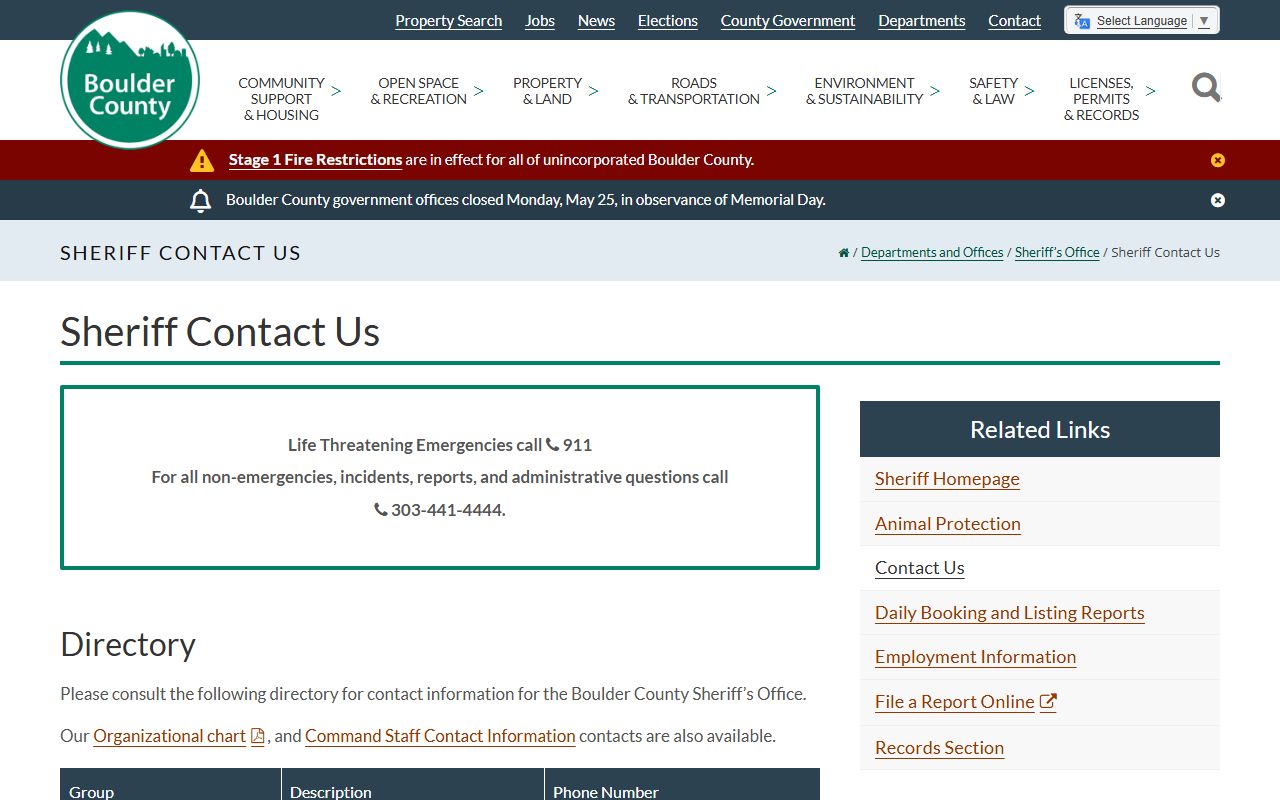
The directory lists the Warrants line at 303-441-3750, the records line, and the law-enforcement-only extradition numbers, all in one place.
Boulder County Warrant Search Fields
The court Docket Search exposes a wide set of filter fields. None of them is labeled "warrant," so the user has to chain a party name or case number with a date range to surface a warrant-related docket entry. The Sheriff records-request portal uses a separate, much shorter field set tied to an official records request. The table below pulls the Docket Search filters that are useful for a Boulder County warrant lookup.
| Field Label | Type | Required | Notes |
|---|---|---|---|
| County | Dropdown | One location filter | Select Boulder County. The 20th Judicial District serves Boulder County only. |
| Courthouse | Dropdown | No | Boulder County Combined Court or Boulder County Combined Court - Longmont. |
| Court Type | Dropdown | No | Both, County, or District. Use Both when the warrant type is unknown. |
| Date Range | Dropdown | Yes | 6 Months, 3 Months, 1 Month, 1 Week, Today, or Specific Date. |
| Case Class | Dropdown | No | CR for felony, M for misdemeanor, T for traffic, JD for juvenile delinquency. |
| Last Name | Text | No | Party last name. Pair with the date range to meet the search rule. |
| First Name | Text | No | Use to narrow common last names. |
| Case Number | Text | No | Year + case class + sequence, such as 2024CR1234. |
The Sheriff's records request portal asks for the requester's name, contact details, the type of record, and details of the event, such as a case number, a report number, an incident date, or the names of people involved. The Sheriff's office uses that input to pull arrest and warrant-related records under the Colorado Criminal Justice Records Act.
What a Boulder County Warrant Record Shows
A warrant entry in a Boulder County case file ties the order to a defendant, a charge, and a court division. Some fields are masked or held back under the Colorado Criminal Justice Records Act and the Public Access to Court Records directive. The list below sets out the fields a court or Sheriff system normally holds for a warrant.
| Field | What It Shows |
|---|---|
| Warrant Type | Arrest, bench, search, fugitive, or federal. |
| Issuing Court | Boulder County District Court or Boulder County Court within the 20th Judicial District. |
| Case Number | Year + case class + sequence, such as 2024CR1234 or 2025M567. |
| Defendant Name | Full legal name as listed in the court file. |
| Charges | Underlying charge, or the failure-to-appear or failure-to-comply reason for a bench warrant. |
| Bond Amount | Cash, surety, property, or personal recognizance amount; or no-bond status. |
| Issue Date | Date the judge or magistrate signed the warrant. |
| Status | Active, served, recalled, or quashed. |
Date of birth and other identifiers are restricted in public view. Extradition limits, the next court date after resolution, and service notes may also sit in the case file. For sealed or under-seal warrants, none of these fields are public.
What to Do If You Have an Outstanding Warrant
The Boulder County court page has a Walk-In Warrant Information section. The stated goal is to let criminal defendants with active warrants get cases added to the docket and back on track as fast as possible. The 20th Judicial District Walk-In Warrant Procedures set out the steps, and a posted list of Victim Rights Act crimes spells out the cases that are not eligible. Walk-in routes do not work for every warrant, so confirm eligibility before showing up.
- Do not rely on unofficial warrant sites or rumor.
- Call Boulder County Courts at 303-441-3750 or appear in person with a photo ID at a police department or the Sheriff's Office.
- If the warrant is in a pending Boulder criminal case, ask about the 20th Judicial District Walk-In Warrant Procedures.
- Confirm eligibility; VRA crimes are excluded from walk-in resolution.
- If eligible, appear as instructed to get the case added to a docket.
- Be ready for bond, custody, a new hearing date, a protection or no-contact order, or compliance conditions.
- If the person is taken into custody and bond is set, bonding is open 24 hours a day in the Boulder County Jail lobby.
Important: Talk to a defense lawyer or the Boulder office of the Colorado State Public Defender at 303-444-2322 before you walk in. A short call can save a long stay.
For complex cases or out-of-state warrants, an attorney is the best first call. People already booked at the jail can be cross-checked with the Boulder County inmate records page. For the broader case file, use Boulder County court records or the Clerk of Court.
Crime Stoppers and Anonymous Tips
Northern Colorado Crime Stoppers covers Boulder County and takes anonymous tips on wanted people, fugitives, and unsolved cases. The tip line is 1-800-222-TIPS (8477). The Boulder Police Department also runs its own tip line at 303-441-1974. Cash rewards may be paid for a tip that helps law enforcement make an arrest or close a case. The tip itself stays anonymous; the caller does not have to give a name or appear in court.
Tips are not a substitute for a 911 call when a person is in immediate danger. The Sheriff's Office also takes tips through its non-emergency dispatch line at 303-441-4444.
Restricted Boulder County Warrant Records
Not every warrant is public. Sealed and under-seal warrants, search-warrant affidavits during an open investigation, juvenile warrants, and warrants in suppressed cases are all restricted. The Colorado Criminal Justice Records Act and the Public Access to Court Records directive set the rules. The court record request form warns that suppressed cases, juvenile records, and certain confidential or protected documents may need a U.S. photo ID or a court order before release.
Federal warrants run on a separate track. The U.S. District Court for the District of Colorado issues them, and the U.S. Marshals Service District of Colorado serves them. Federal warrant content is held in PACER and is not searchable through the state Docket Search. The U.S. Attorney's Office for the District of Colorado prosecutes federal cases tied to those warrants.
Victims of crimes tied to a warrant-listed defendant can get help through Boulder County. The Sheriff's Victim Assistance line is 303-441-3656. The District Attorney's Victim Assistance program runs out of the Boulder County District Attorney's office and covers victim input, restitution, protection-order coordination, and Crime Victim Compensation. Victims of warrant-listed defendants should also ask about no-contact terms and court notice rules.
For the larger statutory framework on warrants and arrest procedure in Colorado, see 2025 C.R.S. Title 16. The Sheriff's main public hub is the Boulder County Sheriff homepage.
The home page is the main launch point for jail, records, civil paper, and warrants questions, and it routes the public to the right unit for each task.